Executive Summary: Selecting dogs for South AfricaSelecting the right dogs for South Africa requires more than personal taste. It demands a clear understanding of how a dog’s body handles heat, cold, humidity, and sunlight. South Africa’s climates range from the humid subtropical coast of KwaZulu-Natal to the freezing Drakensberg mountains and the scorching Karoo desert. This report matches each major climate zone with breeds whose anatomy, including snout length, coat type, body size, and ear structure, naturally suits the local conditions. The Basenji and Whippet thrive in humid coastal heat, while the Pharaoh Hound and Africanis excel in the arid Karoo. In the Mediterranean Western Cape, the Rhodesian Ridgeback proves ideal. The Boerboel prospers on the Highveld, just as the Siberian Husky belongs in the alpine Drakensberg during winter. By aligning breed traits with climate, owners can prevent heatstroke, skin disease, and other environment-related health problems before they start.
Introduction to climate suited dog breeds
Living with dogs for South Africa means sharing your home with a companion whose comfort depends entirely on the environment you provide. A cold, wet winter in the Cape can leave a thin-coated breed shivering uncontrollably, while a summer afternoon in Limpopo can overwhelm a thick-furred Arctic dog within minutes. Too often, owners fall in love with a breed’s appearance or reputation, only to watch their new family member struggle against the very air it breathes. Panting becomes desperate, skin conditions flare up, and veterinary visits multiply, all because the dog’s body was never designed for the climate it now calls home.
The solution lies in understanding the physics of how dogs exchange heat with their surroundings. A long, narrow snout creates a large internal surface area for cooling. Similarly, a short, single-layer coat allows heat to escape quickly. Large, erect ears act as natural radiators. These traits represent vital survival tools shaped by millennia of evolution rather than mere cosmetic features. By matching a breed’s anatomy to a region’s temperature, humidity, and solar intensity, we give the dog a fair chance to live comfortably without constant human intervention. The right match translates to less stress, fewer health emergencies, and a happier, more relaxed companion.
Across the country, six distinct climate zones demand six distinct sets of physical traits from our dogs for South Africa. The humid east coast requires dogs that can cool themselves even when the air is already saturated with moisture. The arid Karoo calls for animals built to handle searing sun by day and freezing cold by night. The Mediterranean southwest combines wet winters with intense ultraviolet radiation. The Highveld’s high altitude brings dramatic temperature swings and summer thunderstorms. The alpine mountains require true cold-weather specialists. Finally, the hot, tick-filled Lowveld demands short coats that make parasite checks easy. What follows is a zone-by-zone guide that puts biology first, ensuring every dog has a fighting chance to thrive.
The Humid Subtropical Coast for dogs for hot weather: KwaZulu-Natal and the Eastern Seaboard
Along the eastern coastline, the warm Agulhas Current pushes moisture-laden air inland. This creates a challenging environment for many imported breeds, as summer humidity here often exceeds 80%. In these conditions, a dog’s primary cooling method, panting, loses much of its effectiveness. When the air already holds a high concentration of water vapour, evaporation from the tongue and airways slows dramatically. A dog can pant for hours yet continue to overheat. This zone also encourages relentless flea and tick populations. The constant dampness trapped against the skin also leads to bacterial and yeast infections, especially in breeds with heavy coats.
Weather appropriate dog breeds that thrive here
Basenji
Originating in the dense rainforests of Central Africa, the Basenji carries a genetic memory of high humidity and high heat. Its coat is extraordinarily short and fine, drying almost instantly after rain or a swim. Large, upright ears function as thermal radiators. When the dog warms up, blood vessels in the ears dilate, releasing excess heat directly into the air. The breed’s lean body and low body fat further prevent internal heat buildup. Owners along the KwaZulu-Natal coast often note that these ideal dogs for South Africa remain active and comfortable even on days when other dogs refuse to move.
Whippet
The Whippet’s almost complete lack of insulating fat, combined with an ultra-short, smooth coat, makes it a natural for humid environments. Its deep chest supports efficient circulation, helping move warm blood to the skin’s surface where it can dissipate. Because the coat offers no hiding places for ticks and fleas, parasite checks remain straightforward. Whippets also have a low resting metabolic rate, meaning they generate little internal heat when resting. However, owners must diligently monitor their extremely thin skin, which remains vulnerable to humidity-related fungal issues compared to a self-grooming breed like the Basenji.
Incompatible choices: Any breed with a thick double coat (Siberian Husky, Alaskan Malamute, Samoyed) will trap humid heat against the skin. This leads to chronic overheating and severe skin infections. Brachycephalic breeds such as English Bulldogs, French Bulldogs, and Pugs face a near-certain risk of respiratory distress. Their compromised airways cannot compensate for humidity-reduced panting efficiency.
The Arid Deserts and Karoo Plateau for dogs for South Africa: Northern Cape and Interior
This vast region presents a paradox. Daytime temperatures can soar past 50°C in the shade, yet winter nights drop well below freezing. The air holds almost no moisture, so there is no cloud cover to moderate either extreme. Ground surfaces absorb intense solar radiation, becoming hot enough to burn paw pads within seconds. Any animal living here must reflect sunlight, elevate its body away from the hot ground, and possess enough resilience to handle the sharp night-time chill.
Climate suited dog breeds that thrive here
Pharaoh Hound and Saluki
Both breeds descend from ancient desert hunters of the Middle East and the Mediterranean. Their long, slender legs keep the core body well above the sun-baked earth. The coat is sparse, coarse, and typically light in colour, reflecting a high percentage of solar radiation. Neither breed carries an insulating undercoat, ensuring any metabolic heat generated during movement dissipates immediately. While these sight-hounds need access to shelter and warm bedding for the freezing nights, their daytime heat tolerance remains unmatched.
Africanis
The Africanis is not a manufactured breed. Rather, it is a landrace dog shaped by centuries of natural selection across Southern Africa. Migrating peoples arrived with them around 570 AD, and the breed has since adapted to the full range of local climates. Because it is a landrace, populations vary significantly by region, but the Karoo variety typically displays a medium-sized, lean frame. Its short, dense coat offers ample protection against the sun without trapping heat. Furthermore, its skin is often darkly pigmented, serving as a biological defence against ultraviolet damage. Behaviourally, it instinctively conserves energy during the midday peak. It also remains hardy enough to sleep outside on cold desert nights if necessary.
Incompatible choices: Giant breeds with heavy musculature and thick coats, such as Saint Bernards, Newfoundlands, and Bernese Mountain Dogs, produce high resting metabolic heat. They cannot shed it quickly in arid conditions. Their mass alone makes them dangerously susceptible to heatstroke under the Karoo sun.
The Karoo survival cycle
04:00 AM
Thermometers plummet past freezing. Lean breeds desperately seek insulated shelter to survive the chill.
14:00 PM
Relentless solar radiation bakes the earth. Searing ground temperatures burn unprotected paws instantly.
19:00 PM
Dry evening breezes flush away the extreme heat. Dogs safely resume their natural foraging behaviours.
The Mediterranean Southwest for climate suited dog breeds: Western Cape
The Western Cape operates on an inverted seasonal rhythm. Cold, wet, windy winters fed by Atlantic fronts give way to long, dry summers with relentless sunshine. The ultraviolet index here ranks among the highest in the world. To thrive here, dogs for South Africa must handle driving rain and wind chill in winter, yet avoid overheating and sun-induced cancers in summer. Coat pigmentation becomes especially critical, as white or thinly furred skin faces a significantly elevated risk of squamous cell carcinoma.
Weather appropriate dog breeds that thrive here
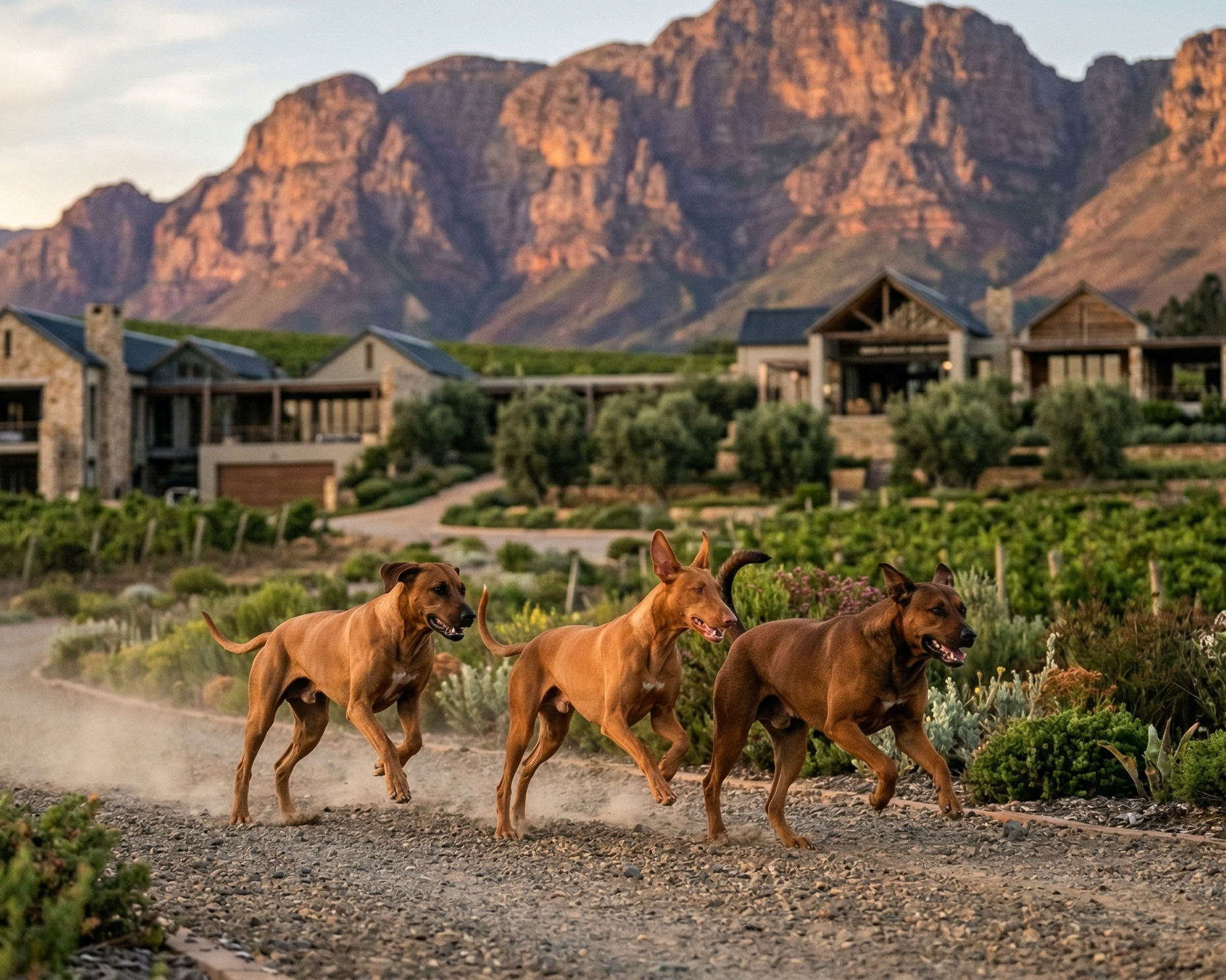
Rhodesian Ridgeback
Early breeders developed the Rhodesian Ridgeback in Southern Africa by crossing European breeds with indigenous Khoikhoi dogs. Today, it embodies climatic elasticity. Its short, sleek coat sheds rain quickly and resists the abrasive winter winds, while its dense structure provides adequate insulation during cold fronts. The skin beneath is heavily pigmented, offering natural protection against the region’s high UV exposure. Ridgebacks are known to dig cool earth to lie in during summer heatwaves. This habit demonstrates adaptive behaviour that perfectly complements their physical traits.
Jack Russell Terrier
The Jack Russell’s harsh, dense coat, whether smooth, broken, or rough, acts as an effective windbreaker and water repellent against Cape winter rains. Its small stature means a high surface area-to-mass ratio, allowing rapid heat dissipation in summer without sacrificing the ability to generate enough metabolic warmth during passing cold fronts. The breed’s sturdy, resilient constitution aligns beautifully with the region’s fluctuating conditions. Despite this natural resilience, practical reality dictates that many Jack Russells still require a winter jacket during the most freezing, horizontal Cape rainstorms.
Incompatible choices: Hairless breeds such as the Chinese Crested or Xoloitzcuintli, alongside those with extremely fine, unpigmented coats, face severe sunburn and cumulative DNA damage from the Western Cape’s UV levels. Without adequate melanin, the risk of actinic keratosis and aggressive skin cancers becomes unacceptably high.
The Humid Highlands and Highveld for dogs for South Africa: Gauteng, Free State, North West
At elevations above 1,700 metres, the Highveld experiences a temperate climate with mild summers punctuated by violent afternoon thunderstorms. It also features dry winters with frosty nights and crisp days. The altitude notably increases UV intensity. Excellent dogs for South Africa living here need coats that handle sudden temperature shifts, paw pads resistant to cold pavements, and temperaments steady enough to weather the loud summer storms without crippling anxiety.
Climate suited dog breeds that thrive here
Boerboel
Early farmers developed the Boerboel across the harsh Cape frontier before the breed moved into the interior plateau. They required a guardian capable of withstanding extreme environmental demands. Its short, dense coat repels both dry winter cold and intense summer sun. The breed standard mandates dark pigmentation on the skin, nose, lips, mouth, and footpads, providing a crucial feature for UV protection at high altitude. Despite its substantial size, the Boerboel exhibits a remarkable tolerance for both the frosty mornings and the moderate summer heat of the region. While storm phobias always depend on the individual dog, this breed’s confident, grounded temperament generally makes it less prone to anxiety than many sensitive breeds.
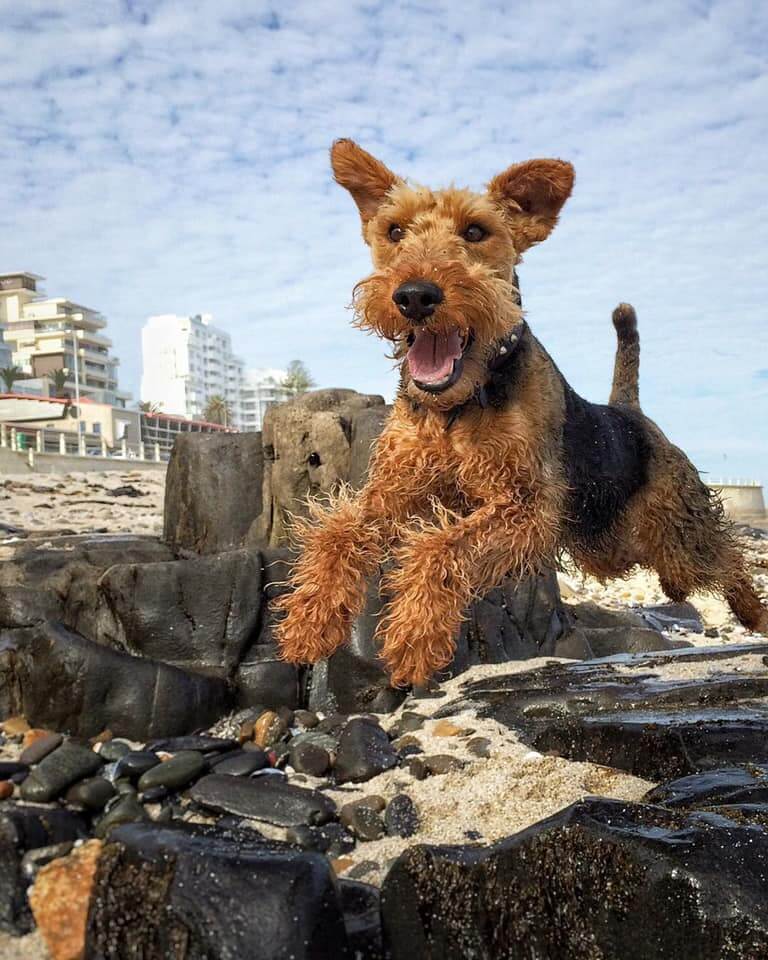
Airedale Terrier
As the largest of the terriers, the Airedale carries a wiry double coat that provides excellent insulation against freezing Highveld mornings. Impressively, this coat still allows convective airflow during warmer afternoons. The wiry texture sheds moisture and dirt effortlessly. The breed’s robust, working-dog physiology handles the region’s altitude and temperature fluctuations with ease.
Incompatible choices: Breeds with exceptionally thin coats and minimal body fat, including Italian Greyhounds and Mexican Hairless Dogs, struggle with the Highveld’s winter cold. They often require constant artificial clothing to prevent shivering and skin desiccation. They simply make a poor natural fit for the environment.
The Alpine and Sub-Alpine Regions for cold climate dog breeds: Drakensberg Mountains
The Drakensberg represents the coldest climatic zone in South Africa, with frequent winter snowfall, black frost, and freezing winds. However, summer temperatures can still easily reach 25°C. For specialist dogs for South Africa, survival here demands maximum thermal insulation during winter. They require a dense double coat, specialised paw pads to resist ice, and a body mass that minimises the surface area-to-mass ratio for heat loss.
Cold climate dog breeds that thrive here
Siberian Husky and Alaskan Malamute
Both breeds originate from the Arctic and sub-Arctic, where they evolved to work outdoors in sub-zero conditions. Their plush undercoats trap a layer of warm air against the skin, while the longer outer guard hairs repel snow and moisture. Counter-current vascular structures in their paw pads directly prevent frostbite on icy terrain. In the Drakensberg winter, these dogs come into their element, displaying an energy and enthusiasm that disappears in warmer parts of the country. Crucially, owners must strictly manage their exercise during the summer months, as temperatures reaching 25°C remain dangerously hot for Arctic breeds.
Anatolian Shepherd
For those needing a livestock guardian in the mountains, the Anatolian Shepherd offers a robust alternative. Originating in the high, rugged plateaus of Turkey, this breed grows a dense double coat that thickens significantly in winter, effectively protecting its large frame from wind and snow. While listed here for its winter resilience, the Anatolian actually boasts remarkable heat tolerance. This adaptability allows it to easily handle arid summer environments like the Karoo and Highveld without distress.
Incompatible choices: Lean, short-haired breeds lacking an undercoat, like Greyhounds, Pointers, Boxers, and Doberman Pinschers, cannot maintain core temperature in alpine winter conditions. Without constant artificial heating and indoor housing, they face rapid hypothermia.
The Lowveld and Northern Bushveld for dogs for hot weather: Limpopo, Mpumalanga
The Lowveld sits at lower altitudes, creating a hot savanna environment with a punishing dry-season heat followed by summer rains that bring moderate humidity. The greatest health threat here is not temperature alone, but rather the dense population of ticks carrying Babesia rossi (biliary) and Ehrlichia canis. Successful dogs for South Africa must combine exceptional heat tolerance with a coat that allows for thorough, daily tick checks.
Weather appropriate dog breeds that thrive here
Greyhound
Despite modern associations with cooler climates, the Greyhound’s ancient ancestors originated in North Africa and the Middle East, where heat tolerance was a survival necessity. Its ultra-short, single-layer coat provides absolutely no hiding places for ticks. Owners can visually inspect and remove parasites immediately after walks, drastically reducing transmission risk. The lean, aerodynamic body prevents heat retention, helping it stay comfortable even on sweltering afternoons. However, owners must exercise caution off-trail; their extremely thin skin remains highly vulnerable to severe lacerations in the thorny Acacia bushveld.
Africanis
As in the Karoo, the Africanis proves itself perfectly suited to the Lowveld. Having evolved within this exact savanna ecosystem, it possesses not only the physical traits for heat management, but also a robust immune constitution shaped by generations of exposure to endemic pathogens. Its short coat facilitates easy parasite management, providing a critical advantage in a region where tick-borne diseases are rampant, while its sturdier skin resists bushveld scratches.
Incompatible choices: Any breed with a long, dense, or corded coat, such as Standard Poodles, Bergamascos, Old English Sheepdogs, and Chow Chows, faces a double hazard. The heavy coat traps heat, leading directly to thermal stress. It also becomes nearly impossible to locate and remove tiny ticks before they transmit disease. This morphological blind spot creates a fatal vulnerability in an area where biliary and ehrlichiosis are endemic.
FAQs on dogs for South Africa
Which dog breed is best for hot, humid climates in South Africa?
The Basenji and Whippet are top choices. Both have ultra-short coats that dry quickly, lean bodies that shed heat efficiently, and anatomical features such as large ears (Basenji) or deep chests (Whippet) that aid cooling when humidity limits panting effectiveness.
What dog breeds handle the cold well in South Africa?
For the Drakensberg and other high-altitude areas, Siberian Huskies, Alaskan Malamutes, and Anatolian Shepherds thrive. These breeds possess dense double coats, paw structures suited for ice, and body masses that conserve heat.
Is a Boerboel suitable for the Highveld climate?
Yes. Early farmers developed the Boerboel to conquer the diverse South African interior, making it well-adapted to the Highveld’s combination of summer thunderstorms, winter frost, and high UV levels. Its short, dense coat and dark pigmentation provide necessary protection.
Can a Rhodesian Ridgeback live comfortably in Cape Town?
Absolutely. The breed’s short, weather-resistant coat handles winter rain and wind, while its heavily pigmented skin offers excellent protection against the Western Cape’s intense ultraviolet radiation. Ridgebacks also tolerate the dry summer heat remarkably well.
What dogs should never be kept in KwaZulu-Natal?
Brachycephalic breeds like English Bulldogs, French Bulldogs, and Pugs, alongside thick-coated Arctic breeds such as Huskies and Malamutes, should avoid this region entirely. The former cannot pant effectively in high humidity; the latter trap humid heat against the skin, leading to rapid overheating and skin disease.
Are Greyhounds okay in hot areas like Limpopo?
Yes, Greyhounds are surprisingly well-suited to hot climates, provided they stay clear of thorny bush. Their extremely short coat, lean build, and low resting metabolic rate effectively help them stay cool. Additionally, the short coat makes daily tick checks easy.
Which breed is best for a farm in the Karoo?
The Africanis is an excellent all-round choice for the Karoo. It has evolved over centuries to expertly handle the region’s extreme temperature swings, intense sun, and sparse resources. Its short coat and lean frame suit the arid environment, and its dark skin provides essential UV protection.
Do Jack Russell Terriers cope with Cape winters?
Yes. Jack Russells have a harsh, dense coat that repels water and wind, keeping them surprisingly comfortable during cold, wet Cape winters. Their small size allows them to warm up quickly, ensuring they remain active, though a jacket helps during extreme storms.
What makes the Africanis such a versatile breed for South Africa?
The Africanis is a landrace dog shaped by natural selection across Southern Africa over many centuries. It has naturally developed a lean, functional build, a short coat suitable for both heat and moderate cold, and a robust constitution that actively helps it resist local parasites and diseases.
How can I tell if a breed is climate-compatible before buying?
Look carefully at its anatomical traits. Consider snout length (long is better for cooling), coat type (short and single for hot areas; double and dense for cold), body fat (low for heat retention), and ear size (large, erect ears aid heat dissipation). Always avoid brachycephalic faces and thick double coats in warm, humid, or arid regions.
Closing thoughts on climate suited dog breeds
Choosing proper dogs for South Africa based on environmental compatibility is an act of kindness that pays dividends in health, comfort, and companionship. By matching a breed’s anatomy to the environmental demands of a specific South African region, whether the humid coast, the freezing mountains, or the sun-baked Karoo, owners give their dogs the best possible foundation for a long, happy life. The research is clear: a dog built for the cold will struggle in the heat, and a dog designed for arid plains will not thrive in coastal humidity. Fortunately, South Africa offers a breed for every zone, ranging from the ancient, resilient Africanis to specialised cold-weather workers like the Siberian Husky. When biology leads the decision, both dog and owner win.