
Executive Summary
Working dog training represents the highest expression of canine learning science. Service dogs and detection dogs perform tasks that ordinary pets never come close to attempting. The methods behind their success combine careful early selection with advanced learning techniques. What emerges is a small elite of dogs that meet the demands of operational work.
Understanding Working Dog Training
Working dog training begins long before formal lessons start. The category covers an unusual range of roles. These include military and law enforcement protection, explosive and narcotics detection, and medical or physical assistance work. Together these dogs form a highly specialised elite within the global canine population.
Operational success in any of these fields depends on two things working together. Programmes need precise advanced training methods, and they also need accurate early selection of candidates. Both matter for the same underlying reason. Failure rates in working dog programmes can run exceptionally high, and the financial and time costs of each candidate run high too.
The biological foundations matter as much as the training itself. A dog’s inherent predispositions, behavioural ecology and structural movement patterns largely determine its occupational viability. No amount of training can overcome the wrong starting material. As a result, selection has become a science in its own right.
Early Selection of Elite Working Dogs
To make the best use of resources, researchers have developed sophisticated assessment techniques. These forecast adult working success from the juvenile stage. The Transportation Security Administration runs one of the most studied programmes through its Canine Breeding and Development Centre. Their evaluations have shown remarkable predictive validity.
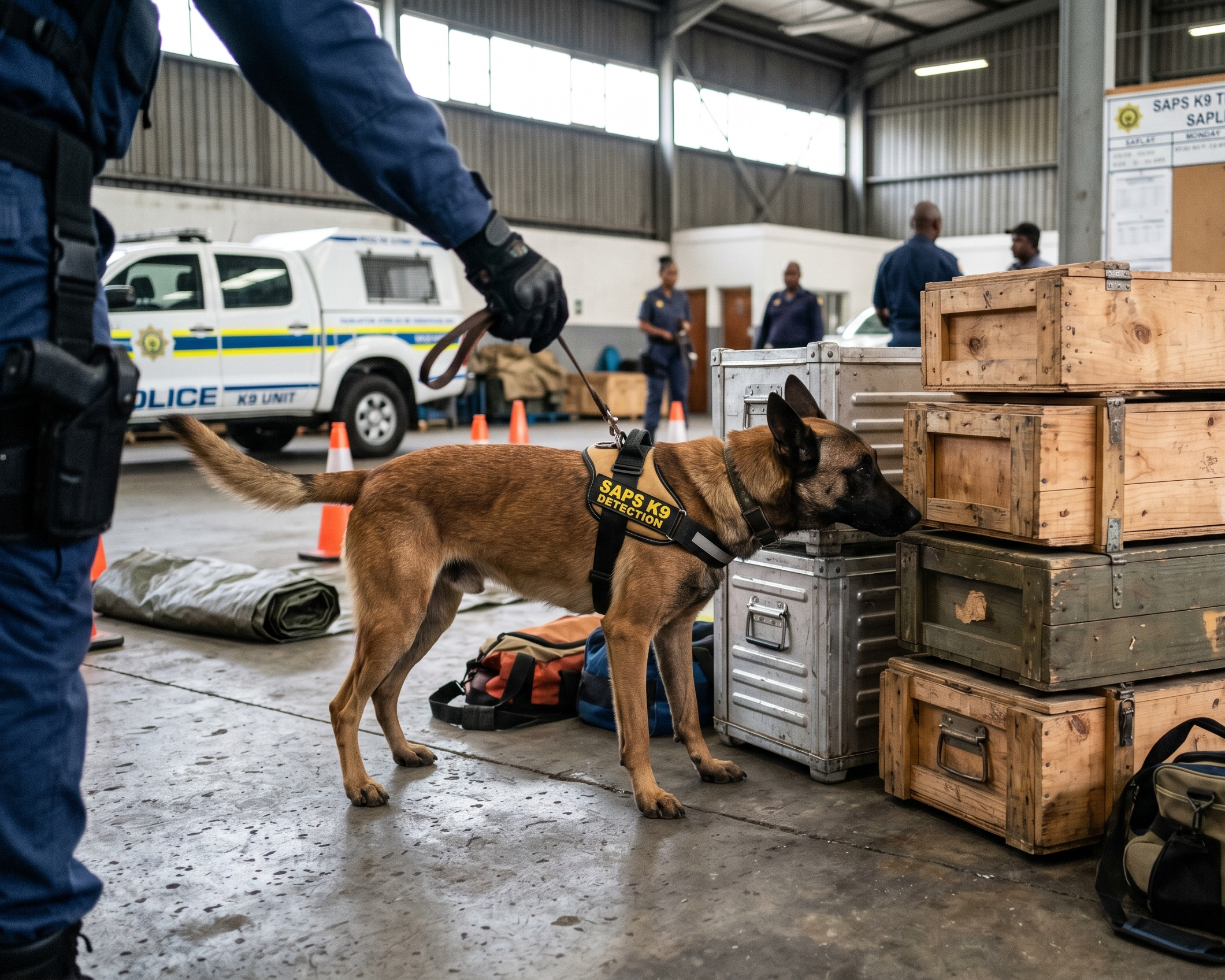
The TSA tests candidate detection puppies at three points in their early development. The first assessment happens at three months of age, followed by a second round at five months. A final evaluation comes at eleven months. Each round examines the domains that matter most for single-purpose detection work. These cover sensitivity to novel environmental stimuli alongside innate search drive and retrieval ability.
Statistical analysis reveals consistent results across independent observers, with the testing matrix proving both objective and reproducible. Researchers establish convergent validity through a careful comparison. They match live behaviour test scores against expert trainer ratings on the Canine Behavioural Assessment and Research Questionnaire. Most strikingly, this approach to working dog training can predict an individual dog’s outcome. The prediction holds reliably from as early as three months of age.
How Service and Detection Dogs Differ
The cognitive predictors of success in working dog training vary substantially by role. Service dogs and detection dogs need fundamentally different mental profiles. Successful service dog candidates show strong inferential reasoning ability. They also display an innate tendency to seek human facial contact and eye gaze. This shows up particularly when tasks become unsolvable or social interaction breaks off.
This natural sociability fits the requirements of service work precisely. A guide dog or mobility assistance dog operates in constant partnership with its handler. The dog anticipates needs and seeks direction continually. Without an innate pull towards the human face, this kind of partnership cannot really function. Service dog training therefore emphasises social attentiveness above almost everything else.
Elite detection dogs work along different lines entirely. They do not rely heavily on human gaze. Successful detection candidates show exceptional short-term memory and the ability to interpret human pointing gestures from a distance. They also display strong independent persistence. These traits let a detection dog navigate complex search areas alone. The dog retains its instructions without constantly checking back with the handler.
Advanced Working Dog Training Techniques
Once candidates pass selection, optimising their performance requires methods well beyond basic associative learning. The most demanding olfactory tasks include accelerant detection and home-made explosive detection. For work of this complexity, trainers use exemplar training. This represents some of the most advanced working dog training currently practised.
Exemplar training exposes the dog to a wide range of positive and negative stimuli. Positive stimuli match the target while negative stimuli do not. The aim is building complex conceptual discriminations. A larger exemplar set builds stronger conceptual understanding. With enough exposure to varied examples, the dog learns to recognise the underlying category itself. Specific examples then act as reference points for that broader concept.
Odour Discrimination in the Field
Pure target odours rarely appear in real working environments. The world is full of competing smells. To prepare working dogs for this reality, trainers use odour mixture discrimination training. Trainers embed the target odour within complex compound odours that distract and confuse.
The approach produces far better field generalisation than pure-target training. A dog trained only on isolated target scents struggles in messy real-world environments. By contrast, a dog trained on mixed odour profiles handles complexity as routine. The advanced working dog training paradigm now treats this kind of mixed-odour exposure as standard practice.
Errorless Learning for Detection Dog Training
For the most challenging environmental discriminations, trainers turn to errorless discrimination learning. The technique avoids inducing frustration in the dog. At the start of training, trainers make the correct stimulus highly salient and obvious. This makes any response to the incorrect stimulus practically impossible.
The non-target stimuli then fade gradually into the environment, eventually reaching the same intensity as the target. The slow progression maintains a high rate of reinforcement throughout. It prevents the rehearsal of errors entirely. As a result, this kind of working dog training produces reliable indication behaviours. The behaviours hold up under operational conditions without breaking down.
Working dogs require a strict, balanced whole-food diet.
The Future of Working Dog Training
The picture is one of careful integration between two streams of work. Predictive selection identifies suitable candidates within months of birth. Then advanced cognitive conditioning develops them into operational specialists. Together these two streams represent the current state of the art in working dog training.
What separates a working dog from an ordinary pet is alignment. The dog’s inherited cognitive profile must meet a programme designed precisely around it. Working dog training really delivers only when both halves match up. Without that match, even the cleverest and most willing dog will fall short of operational standards. Alignment is the whole game.