Executive Summary
The science of dog agility reveals a fascinating transformation from a simple exhibition into a rigorous athletic discipline. Consequently, this intense sport fundamentally alters a dog’s physics, biology, and neurological pathways. Humans experience profound health improvements and forge unparalleled psychological connections with their canine partners. Ultimately, lifelong participation serves as a powerful shield against cognitive decline for ageing animals.
Introduction to the Science of Dog Agility
The science of dog agility traces its origins to a surprisingly simple entertainment problem. In 1977, the internationally renowned Crufts Dog Show faced a scheduling dilemma. Organisers needed an entertaining filler to keep audiences awake. A gap existed between the obedience championships and the breed conformation judging. John Varley managed the committee during this period. He possessed extensive knowledge of equestrian show jumping. However, he lacked the specific behavioural expertise to adapt a course for dogs.
Consequently, Varley collaborated with an established trainer named Peter Meanwell. Meanwell accepted the commission to engineer a structurally safe obstacle course. He wanted the course to look visually captivating for the audience. Additionally, the equipment needed to function safely on hard exhibition flooring. Meanwell borrowed concepts from military canine exercises. Specifically, he studied training methods from the Royal Air Force. He enlisted several colleagues to manufacture the initial equipment.
They introduced a competitive timing element to thrill the spectators. Speed and accuracy suddenly defined winners and losers. In 1978, the first formal demonstration amazed the Crufts audience. Meanwell actually won this inaugural event with his own dog. Understanding the science of dog agility helps us appreciate this rapid evolution. The original course closely mirrored modern layouts. Dogs navigated early versions of tunnels, rigid walls, and catwalks. The public reacted with immediate, overwhelming enthusiasm.
Following this success, the sport spread rapidly across the globe. Corporate sponsors began funding major finals by 1979. The United Kingdom Kennel Club published official competitive regulations in 1980. Soon after, enthusiasts introduced the sport to the United States. Ken Tatsch and Sandra Davis formed the United States Dog Agility Association. They held their first team competition in Texas in 1986. Eventually, global organisations formed to unify international championships.
The Historical Timeline
🐕
1978 Genesis
Crufts hosts the first formal demonstration.
🌍
1980s Expansion
Official rules spread globally to America.
🏆
2016 State Sport
Finland recognises handlers as state athletes.
Dog Agility Health Benefits for Humans
The science of dog agility extends far beyond the canine athlete. Human demographics reveal highly distinct and consistent international patterns. Women dominate this activity across Europe, North America, and Australasia. Specifically, females represent a staggering 85 percent of all handlers. Furthermore, participants largely belong to middle-aged and older demographics. International surveys show that 64 percent exceed 36 years of age. Additionally, nearly a quarter of participants exceed 56 years.
Despite this clear female dominance, sports media frequently distorts the reality. Broadcasters disproportionately feature male handlers in public television segments. This aligns with frustrating societal patterns regarding athletic representation. Handlers choose this sport for deeply internal, psychological reasons. They completely ignore extrinsic rewards like ribbons or public status. Instead, they seek competency, dynamic teamwork, and community connection.
Active participants often manage multiple dogs at competitive levels. Many handlers manage two or even three dogs simultaneously. Consequently, this heavy involvement drastically changes their daily lifestyle. The dog agility health benefits become undeniably apparent in medical statistics. Handlers accumulate massive amounts of moderate cardiovascular exercise every week. They rarely exercise alone, preferring the partnership of their animal.
The science of dog agility proves especially vital for elderly populations. Researchers in Munich conducted a targeted gerontological study recently. They discovered that elderly dog owners walk 120 minutes daily. Non-owners manage a mere 38 minutes of daily walking. Cat owners perform even worse, logging just 17 minutes. Ultimately, 94 percent of active handlers meet daily fitness criteria.
This constant mobility reduces medical interventions significantly. Active older handlers visit their physicians far less frequently. They average 5.3 visits annually compared to 7.8 for non-owners. The shared bond creates a massive psychological anchor for humans. A remarkable 80 percent of older owners refuse residential care. They will not relocate if facilities reject their dogs. They correctly view the animal as essential to their survival.
Canine Agility Biomechanics of Jumping
We must examine canine agility biomechanics to understand injury risks. A jump is never just a simple parabolic leap. Jumping requires a highly sophisticated interplay of muscular power. Dogs must execute precisely timed limb stiffness to survive landings. Advanced scientific cameras help researchers decode these exact physical movements. They found distinct kinetic strategies separating elites from absolute novices.
During the take-off phase, a dog uses asymmetrical leg movements. The leading front leg acts as a rigid vaulting pole. It registers 75 percent stiffer than the trailing leg. This stiffness launches the animal’s centre of mass upwards. However, the mechanical roles invert completely upon landing. The trailing leg hits the ground first and stiffens.
This trailing leg absorbs the massive concussive force of gravity. It instantly transfers descending velocity into forward momentum. Elite dogs utilise a highly synchronised half-bound technique during take-off. They place their back legs simultaneously for maximum propulsive power. Their acceleration force doubles their deceleration force. Furthermore, advanced athletes achieve flat, incredibly fast aerial trajectories.
Beginner dogs exhibit severe mechanical flaws during their runs. They lack the muscular coordination to drive forward propulsion effectively. They place their back legs unevenly, causing unbalanced launches. Most dangerously, beginners fail to control their limb stiffness landing. Their front legs remain 24 percent softer during impact.
Consequently, beginners experience 17 percent higher limb compression. Their muscles undergo severe lengthening under extreme tension. This forced shock absorption explains high shoulder injury rates. The science of dog agility highlights these dangerous biomechanical flaws.
Other obstacles introduce complex lateral and compressive physical forces. The weave poles require explosive, alternating spinal bending. Twelve rigid poles sit exactly 60 centimetres apart. A dog must rotate its head and trunk perfectly. However, the dog actively suppresses its head movement. This stabilisation keeps its eyes fixed on the handler. Meanwhile, its spine violently bends left and right.
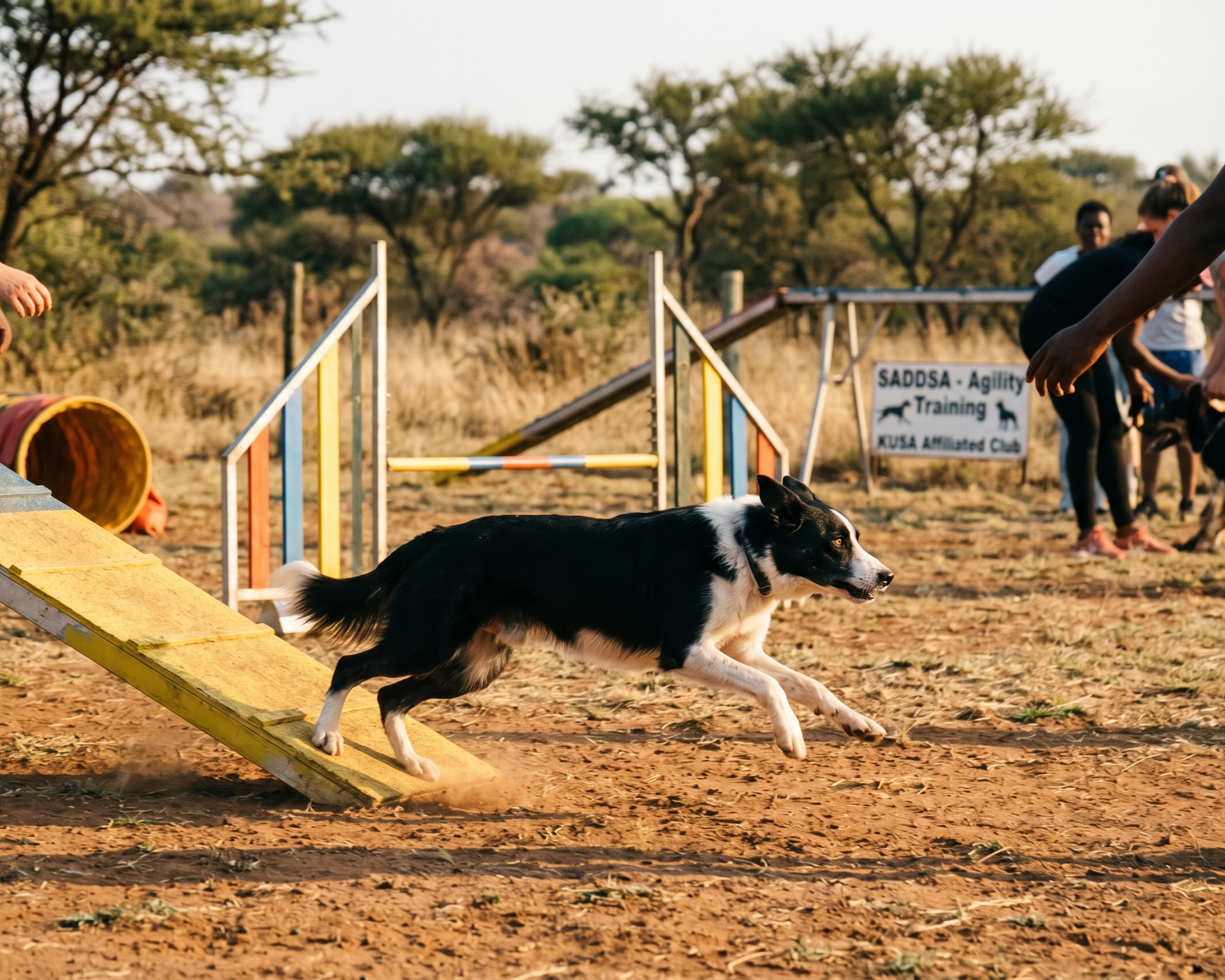
The science of dog agility also scrutinises contact obstacles. The A-frame forces a full sprint against a steep incline. Dogs experience extreme spinal stretching on the way up. Traversing the top apex forces severe, sudden spinal bending. Veterinary professionals blame these mechanical loads for lower back degeneration. Additionally, the teeter requires active, rapid postural control.
Dogs must manage a dropping board in 1.31 seconds. To survive this drop, a dog takes 18.3 tiny steps. The nervous system constantly calculates these micro-adjustments. They must absorb the falling impact while preparing to sprint. A single missed calculation results in a dangerous fall.
Canine Sports Medicine and Injury Risks
The science of dog agility exposes a rising orthopaedic crisis. Course designs demand increasingly difficult technical skills. Breeders consistently select dogs for explosive athletic drive. Consequently, injury rates rise alongside overall course speeds. Researchers tracked running speeds over a recent twelve-year period. Speeds increase systematically by 0.033 yards per second annually.
Physics dictates that increased speed multiplies landing forces. This relentless velocity acts as a dangerous kinetic multiplier. It amplifies concussive trauma applied to the skeletal system. Epidemiological surveys confirm the human cost of this speed. Baseline injury prevalence ranges between 32 and 42 percent. An injury officially keeps a dog sidelined for one week.
The anatomical distribution of trauma directly matches the movements. The front limbs absorb massive braking forces during deceleration. Predictably, the shoulder region represents 30 percent of all injuries. The core stabilising muscles also take heavy damage. The primary hip flexor accounts for nearly 20 percent. Extreme spinal bending causes these painful muscular tears.
Specific physical traits drastically alter a dog’s safety profile. Understanding the science of dog agility helps mitigate these risks. Over half of all competing Border Collies sustain severe injuries. Their explosive speed routinely overloads their biomechanical limits. Furthermore, simple grooming habits dictate orthopaedic health. Failing to trim nails increases injury odds significantly.
The Cost of Speed
Long nails destroy the natural alignment of the foot. They reduce traction and shift impact forces up the leg. Incredibly, long nails increase injury risk by 2.4 times. Surgical removal of front dewclaws causes similar damage. Dewclaws stabilise the wrist during tight, high-speed cornering. Without them, dogs face 1.9 times higher injury odds.
Training methods also impact long-term epidemiology. Teaching weave poles to young puppies seems dangerous initially. However, early exposure actually decreases overall injury risk. Puppies develop vastly superior body awareness before puberty. Conversely, the specific teaching method matters immensely. Methods requiring immediate, violent spinal bending cause early micro-trauma.
The physical demands exact a severe toll on humans too. Handlers must sprint and execute sudden lateral cuts. Twenty-seven percent of handlers suffer lower limb injuries annually. Uneven natural grass causes severe ankle and knee sprains. Handlers who run closely alongside their dogs get hurt most. Doctors recommend intense interval training to protect human joints.
Dog Agility Psychology and Brain Changes
A typical competition run lasts only forty seconds. Yet, the science of dog agility reveals massive metabolic shifts. The explosive output places immense demands on canine biology. Blood tests show lactic acid exceeding normal boundaries quickly. The cardiovascular system cannot supply oxygen fast enough. Muscles must burn energy without oxygen to maintain speed.
The canine circulatory system performs an emergency adaptive response. Red blood cell counts spike immediately following a run. This is not caused by simple dehydration. Instead, intense physical stress triggers a violent splenic contraction. The spleen squeezes itself to dump stored blood cells. This floods the body with instant, highly oxygenated blood.
Beyond physiology, the sport presents profound cognitive challenges. The science of dog agility involves intense neurological mapping. Dogs must process complex geometry at full speed. They interpret rapid verbal cues from a sprinting human. They must suppress impulsive instincts amid chaotic crowd noise. Researchers call this suppression executive inhibitory control.
Building the Ultimate Bond
Training fundamentally alters a dog’s ecological self-awareness. They develop an internal mapping of their body proportions. They understand their exact size relative to the environment. Agility dogs navigate geometric openings much faster than pets. They learn precisely where every limb exists in space. However, this specialised training creates a funny cognitive glitch.
Researchers test dogs using solid barriers like paper walls. Normal pets easily push through the weak paper. Conversely, highly trained athletes fail this simple test. They experience a profound neurological processing conflict. Their brains prioritise trajectories over physical material density. They view a barrier purely as a coordinate to clear.
This sport wires the canine brain for extreme dependence. Cognitive tests contrast these athletes with search and rescue dogs. Handlers place food inside an impossibly sealed plastic container. Search dogs bark and attack the puzzle independently. Alternatively, agility dogs remain silent and gaze at humans. They rely entirely on their handler for the answer.
Fighting Dementia with Competitive Dog Agility
The science of dog agility offers incredible geriatric benefits. The combination of intense exercise and puzzles builds neuroplasticity. Neuroplasticity allows the brain to reorganise neural networks continuously. This malleability persists robustly throughout the adult animal’s lifespan. It allows older dogs to learn complex motor patterns. It significantly refines their emotional regulation abilities.
Lifelong engagement in this sport protects the physical brain. It acts as a shield against Canine Cognitive Dysfunction. This disease mirrors human Alzheimer’s in ageing animals. The Dog Aging Project studied thousands of senior companions. They confirmed a massive link between exercise and brain health. Inactive dogs show severe signs of cognitive decay.
The science of dog agility proves aerobic exercise preserves the mind. Running maintains healthy blood vessels inside the brain. It actively preserves the physical volume of the hippocampus. This effectively slows the biological onset of mental decline. The sport serves as a comprehensive medical intervention. Ultimately, it keeps our canine partners sharper for longer.
Omega’s are crucial for canine physical and mental health, especially in competing animals.