Exercise for three-legged dogs requires a fundamentally different approach than standard canine fitness protocols. When a dog loses a limb, the remaining three legs must compensate for the missing support structure. They redistribute weight and force across joints never designed to bear such asymmetric loads. Consequently, exercise becomes essential for maintaining muscle strength yet dangerous if poorly planned, as overexertion accelerates degenerative joint disease in the compensating limbs.
Many owners struggle with the paradox of knowing their tripod dog needs movement to stay healthy whilst fearing that too much activity will cause harm. Standard exercise advice for four-legged dogs becomes irrelevant because amputation changes the physical reality entirely. Furthermore, veterinary guidance often focuses on immediate post-amputation recovery rather than long-term fitness strategies, leaving owners without a clear roadmap for the months and years that follow.
The key to successful exercise for three-legged dogs lies in understanding how the body adapts to limb loss. From this foundation, owners can build a progressive programme that strengthens stabilising muscles without overwhelming the joints. By recognising the specific weak points created by amputation and tailoring activity to address them, owners can maintain their dog’s mobility and quality of life for years. Therefore, education in biomechanics and gradual conditioning becomes the foundation of long-term soundness.
Tip: Begin all exercise sessions with a five-minute slow walk to warm up muscles and increase blood flow to joints before increasing intensity or duration.
The Biological Function: How Dogs Adapt to Three Legs
Weight Distribution and Biomechanical Changes

A dog’s body is designed for four-legged movement, with the front legs bearing roughly 60% of weight and the rear legs 40% in a standing position. When one limb is removed, the remaining legs must immediately assume greater weight-bearing load. Importantly, the degree of adaptation required depends entirely on which leg was lost, as front-leg amputations create more dramatic shifts than rear-leg losses.
Front-Leg Amputation Impacts
Dogs who lose a front leg experience the most significant shift in weight. The remaining front leg must now bear nearly the entire load previously shared between two limbs. This forces the shoulder, elbow, and wrist joints on the remaining side to endure constant stress during movement. Moreover, the spine must adjust by rotating slightly to maintain balance. This can lead to chronic tension in the back muscles and eventual disc problems if core strength is not actively maintained.
Rear-Leg Amputation Impacts
Rear-leg amputations create less dramatic weight shifts but still demand significant adaptation. The remaining rear leg must provide all forward force during movement. This places immense strain on the hip, knee, and ankle joints. Additionally, the pelvis tilts to make room for the missing limb. This can alter how the dog walks and cause uneven muscle development. Therefore, targeted exercise must address not only the remaining legs but also the core muscles that steady the spine and pelvis during movement.
The body’s natural adaptation process involves growth of the muscles surrounding the remaining limbs as they work harder to compensate. However, this muscular development alone is not enough to protect joints from long-term wear. Consequently, a structured exercise programme must deliberately build strength in stabilising muscles whilst avoiding repetitive high-impact activities that speed up cartilage breakdown.
Causes of Exercise-Related Injury in Three-Legged Dogs
Overcompensation and Joint Overload

The most common cause of exercise-related injury in tripod dogs is asking the remaining limbs to perform work they were never designed to handle alone. When a dog loses a limb, the remaining legs do not magically become stronger overnight. Instead, amputation immediately forces them into service at levels that exceed their physical limits. Consequently, cartilage begins to break down faster than it can repair itself. This leads to arthritis within months or years depending on activity levels.
Front-leg amputees are especially at risk. The remaining front leg must absorb the full impact of landing after jumps or sudden stops. Even activities that seem harmless, such as fetching a ball, can create forces equal to several times the dog’s body weight. These forces concentrate on a single shoulder joint. Therefore, high-impact repetitive activities must be removed entirely or replaced with controlled, low-impact alternatives.
Inadequate Core Strength
Many owners focus only on leg strength when designing exercise programmes. They overlook the critical role of core muscles in maintaining balance and protecting the spine. A weak core forces the legs to work even harder to steady the body during movement. This speeds up joint wear. Moreover, too little strength in the stomach and back allows the spine to twist and press unevenly. This leads to disc problems or chronic pain that limits mobility far more than the original amputation ever did.
Core weakness especially affects dogs who lived quiet lives before amputation. They lack the basic muscle mass needed to adapt well. Consequently, these dogs require dedicated core-strengthening exercises before attempting more demanding physical activities.
Symptoms of Overexertion in Three-Legged Dogs
Physical Symptoms
The earliest physical signs of overexertion include limping or favouring the remaining legs after exercise. This indicates that joints or soft tissues have been stressed beyond their capacity to recover. Swelling around the shoulder, elbow, hip, or stifle joints suggests inflammation from repetitive strain. Furthermore, reluctance to bear weight fully on a leg that was previously sound is a critical warning sign that damage has begun accumulating and rest is immediately required.
Muscle trembling or shaking after exercise shows fatigue severe enough to harm stability. This places the dog at risk for falls or acute injuries. Additionally, excessive panting or laboured breathing that continues long after activity has stopped suggests heart overload. This can strain the heart and lungs without need.
Behavioural Changes
Dogs experiencing chronic overexertion often become reluctant to engage in activities they previously enjoyed, such as walks or play sessions. This reluctance stems from pain or fear of pain. It should never be dismissed as laziness or stubbornness. Moreover, increased aggression or irritability when touched around the joints or spine shows discomfort. This has reached a level where the dog feels the need to protect himself from further harm.
Sleep troubles, including difficulty settling or frequent moving during rest, suggest muscle and bone pain. This prevents the dog from finding a comfortable position. Therefore, any behavioural shift following increased exercise should prompt immediate review of the activity programme.
Chronic Indicators
Long-term overexertion shows up as progressive stiffness, particularly after periods of rest. This indicates advancing arthritis in the compensating joints. Muscle wasting in the remaining limbs strangely signals that pain has become severe enough to discourage use, creating a vicious cycle where weakness leads to further injury. Visible imbalance in muscle development, with one side becoming far larger than the other, suggests uneven loading that will eventually cause physical failure in the overworked leg.
Diagnosis and Veterinary Procedures
Veterinary assessment of a three-legged dog’s fitness for exercise begins with a comprehensive orthopaedic examination. This evaluates range of motion, joint stability, and pain responses in all remaining limbs. The veterinarian will palpate each joint for swelling, heat, or crepitus, which are hallmark signs of degenerative changes. Furthermore, gait analysis allows the clinician to observe compensation patterns and identify abnormal loading that predicts future injury.
Imaging and Baseline Assessment
Radiographs of the remaining limbs provide baseline images of joint structure. They reveal existing conditions such as hip problems or elbow issues that will worsen under increased load. In some cases, advanced imaging such as CT or MRI scans may be necessary to assess soft tissue damage or spinal problems not visible on standard X-rays. Consequently, establishing a clear medical baseline before beginning an exercise programme protects both the dog and the owner from preventable harm.
Regular vet monitoring every six to twelve months is essential for detecting early signs of joint breakdown before they become severe. Vets may also recommend blood work to rule out body-wide conditions such as thyroid problems or Cushing’s disease, which can worsen joint problems and slow recovery from exercise.
The Role of Diet in Exercise for Three-Legged Dogs
Nutrition cannot make up for poor exercise programming. However, it plays a critical supporting role in maintaining joint health and muscle mass. A diet rich in high-quality protein supports muscle repair and growth in the remaining limbs, which are working at full capacity to make up for the missing leg. Importantly, protein intake must be enough to match the increased demands placed on the muscles and skeleton, as too little protein leads to muscle wasting and weakness.
Omega-3’s
Anti-inflammatory omega-3 fatty acids, particularly those derived from marine sources, can help reduce chronic inflammation in overworked joints. However, diet alone cannot reverse existing joint damage or prevent injury caused by excessive mechanical stress. Therefore, whilst nutritional support is valuable, it must be paired with smart exercise design rather than viewed as a substitute for proper movement management.
Weight Management and Joint Protection
Weight management is perhaps the most critical dietary factor. Every kilogramme of excess body weight greatly increases the load on the remaining legs. A lean body condition reduces joint strain and improves mobility, whilst obesity speeds up cartilage breakdown and severely limits exercise tolerance. Consequently, maintaining an ideal weight through portion control and calorie-appropriate food is essential for tripod dogs.
Treatment and Holistic Management
Veterinary Treatment
When dogs sustain exercise-related injuries, vet treatment typically begins with rest and anti-inflammatory drugs to reduce pain and swelling in affected joints. Vets commonly prescribe these drugs for acute flare-ups, though long-term use carries risks of stomach and kidney damage that must be monitored. In severe cases where cartilage damage has progressed to bone-on-bone contact, joint injections containing certain acids or steroids may provide temporary relief, though these ease symptoms rather than cure the problem.
Vets may recommend surgical options such as total hip replacement or joint cleaning procedures in advanced cases. However, these carry significant risks and costs that make prevention through proper exercise programming the far better approach. Consequently, the goal of vet treatment is to manage pain and swelling whilst the owner modifies the exercise protocol to prevent it happening again.
Holistic Support
Hydrotherapy is one of the most effective holistic interventions for three-legged dogs. Water provides resistance for muscle building whilst buoyancy reduces joint loading. Swimming or underwater treadmill sessions allow dogs to exercise at higher intensities than would be safe on land, building cardiovascular fitness and muscle strength without risking acute injury. Moreover, the cooling effect of water reduces post-exercise inflammation, accelerating recovery times.
Physical Therapy
Physical therapy methods such as massage, passive range-of-motion exercises, and targeted stretching help maintain flexibility and reduce muscle tension in the compensating limbs. Joint supplements containing certain compounds may support cartilage health, though evidence for their success is mixed. They should never replace proper exercise management. Additionally, needle therapy and cold laser treatment have shown promise in managing chronic pain linked to overuse injuries, though these are add-on treatments rather than standalone solutions.
Interesting Fact: Three-legged dogs can achieve up to 70% of the speed and agility of their four-legged counterparts when given proper conditioning and biomechanically sound exercise programming.
Designing a Safe Exercise Programme for Three-Legged Dogs
Foundation Phase: Building Core Stability
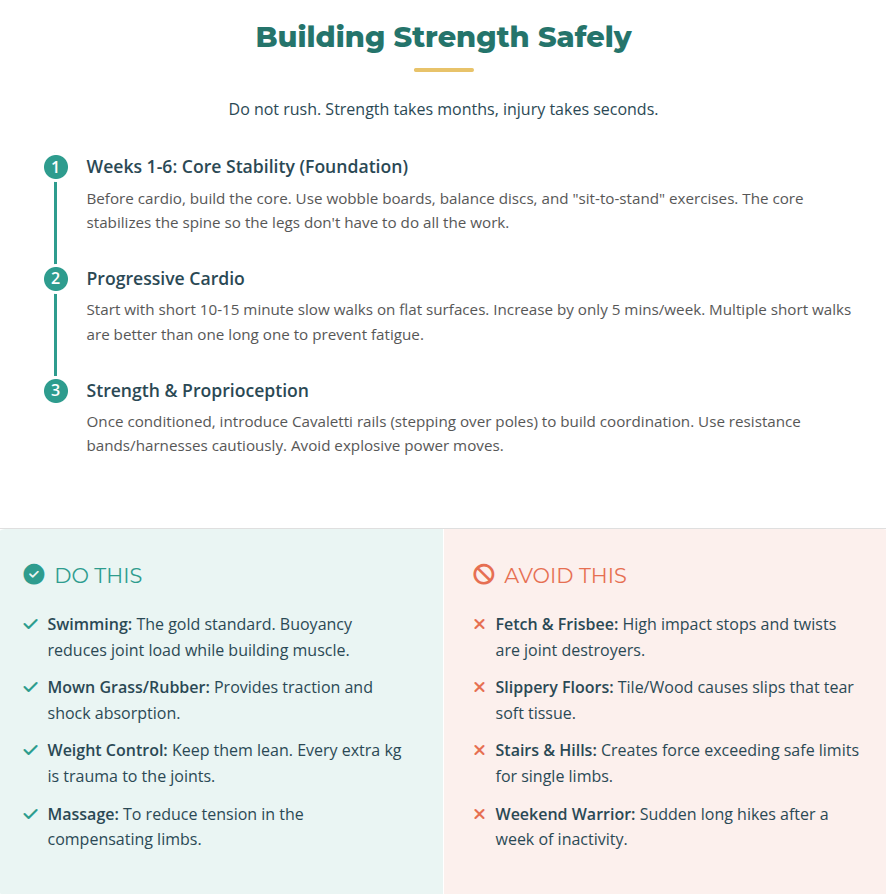
The first phase of exercise for three-legged dogs must focus on developing core strength before introducing any demanding heart or strength work. Core exercises such as balance work on unstable surfaces, sit-to-stand repetitions, and controlled standing holds force the stomach and back muscles to engage without placing excessive load on the limbs. Importantly, this phase should last a minimum of four to six weeks. Rushing into more intense activity without solid core stability sets the stage for injury.
Simple exercises such as standing on a wobble board or balance disc turn on the stabilising muscles surrounding the spine and pelvis. These movements provide low-impact yet highly effective training for building the muscle control needed for safe movement. Furthermore, even elderly or unfit dogs can perform these exercises safely, making them an ideal starting point for any tripod fitness programme.
Progressive Cardiovascular Conditioning
Once core stability has been built, owners can introduce heart-health exercise gradually through controlled leash walking on flat, even surfaces. Initial walks should be short, no more than ten to fifteen minutes. They should increase by only five minutes per week to allow tissues enough time to adapt. Moreover, multiple short walks throughout the day work better than single long sessions, as they prevent buildup of fatigue that leads to poor form and compensating movement patterns.
As tolerance improves, owners can add gentle slopes to build strength in the hindquarters and improve forward power. However, steep hills and stairs should be avoided entirely. They create forces that exceed safe limits for single-limb loading. Therefore, all progress must be careful and based on the individual dog’s response rather than fixed timelines.
Strength Training and Proprioception
Targeted strength exercises such as cavaletti work, where the dog steps over low poles or rails, build coordination and muscle endurance without requiring explosive power. These exercises also improve body sense, which is the body’s ability to know its position in space. This is a critical skill for preventing trips and falls. Additionally, controlled backing exercises strengthen the hindquarters and improve engagement of the core muscles during movement.
Owners can use resistance training with a properly fitted harness and elastic bands to provide gradual overload for building muscle mass in the remaining limbs. However, they must introduce this only after the dog has mastered basic conditioning. Early resistance work on an unstable foundation guarantees injury. Consequently, patience and following a structured plan are essential for long-term success.
Activities to Avoid
High-Impact and Repetitive Activities
Owners must strictly limit or remove high-impact activities such as jumping, playing fetch, or running off-lead with other dogs. These activities generate impact forces that far exceed what a single limb can handle. They rapidly speed up joint degeneration. Moreover, the unpredictable nature of off-lead play creates situations where the dog may be knocked off balance or forced into awkward positions that cause acute injury.
Repetitive motions such as ball-chasing or Frisbee-catching are particularly destructive. They combine high impact with identical movement patterns repeated dozens of times in quick succession. This type of loading creates tiny damage in cartilage that builds up faster than the body can repair it. Therefore, even if the dog shows enthusiasm for these activities, responsible owners must focus on long-term joint health over short-term enjoyment.
Unsafe Surfaces and Terrain
Owners should avoid slippery surfaces such as tile, hardwood, or wet grass whenever possible. These increase the risk of falls and acute injuries from loss of traction. Additionally, uneven terrain such as rocky trails or sandy beaches demands constant balance adjustments that tire the steadying muscles and harm form. Consequently, the safest exercise environments are flat, dry surfaces with good traction, such as mown grass or rubberised walking paths.
FAQs – Exercise for Three-Legged Dogs
How soon after amputation can exercise begin?
Light, controlled movement can begin within days of amputation to prevent muscle atrophy, but formal exercise programmes should wait until surgical healing is complete, typically six to eight weeks. Early movement focuses on short, slow walks for toileting purposes only.
Can three-legged dogs go on long hikes?
Most three-legged dogs lack the endurance and joint resilience for extended hikes. Even well-conditioned tripods should limit outings to distances they have gradually built up to over months, and terrain must remain flat and even to minimise injury risk.
Is swimming safe for all three-legged dogs?
Swimming is generally the safest form of exercise for tripods, but dogs must be monitored for fatigue and should wear a flotation vest for safety. Dogs with front-leg amputations may struggle more with balance in water than rear-leg amputees.
How do I know if my dog is overexerting himself?
Signs include limping after exercise, reluctance to continue walking, excessive panting, muscle trembling, or behavioural changes such as irritability or withdrawal. Any of these symptoms require immediate rest and veterinary consultation.
Can exercise prevent arthritis in the remaining legs?
Appropriate exercise can slow the progression of arthritis by maintaining muscle strength and joint mobility, but it cannot prevent it entirely. The uneven loading inherent to three-legged locomotion will eventually cause degenerative changes regardless of exercise quality.
What is the best surface for exercise?
Mown grass or rubberised surfaces provide the best combination of traction and cushioning. Hard surfaces like concrete accelerate joint wear, whilst slippery surfaces increase fall risk and should be avoided entirely.
In Closing
Exercise for three-legged dogs demands a level of precision and restraint that differs completely from standard canine fitness approaches. By prioritising core stability, avoiding high-impact activities, and progressing conservatively through structured conditioning phases, owners can maintain their dog’s mobility and quality of life for years. Ultimately, the goal is not to restore what was lost. Rather, it is to optimise what remains, building resilience in the compensating limbs whilst protecting them from premature breakdown. We do this through smart routines and unwavering commitment to biomechanically sound exercise for three-legged dogs.