
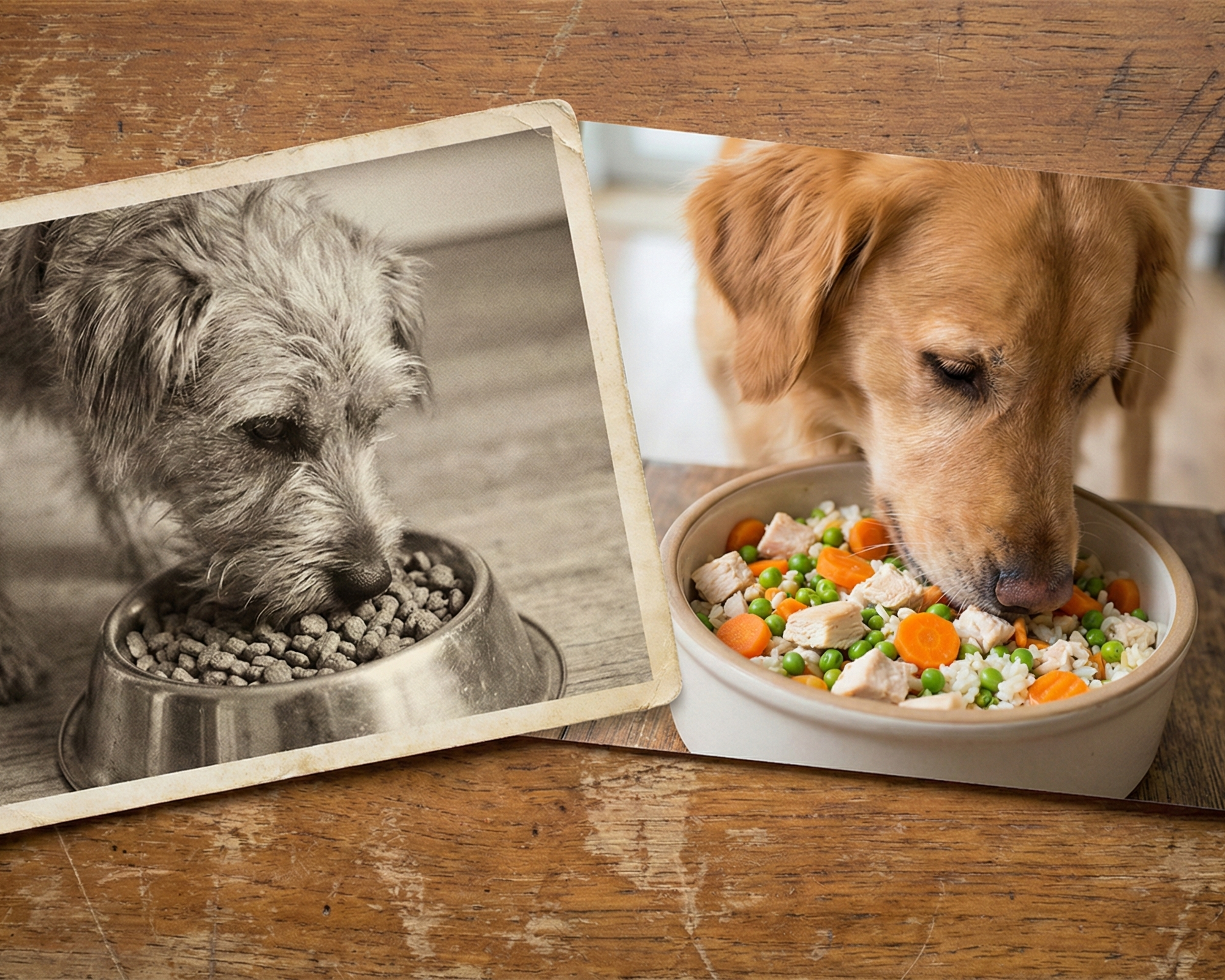
Dog Food Moisture Content: The Hidden Factor That Changes Everything
Dog food moisture content is the single most overlooked factor when pet owners compare different feeding options. Most people glance at a label, see a protein percentage, and assume they understand what their dog is eating. This assumption leads to fundamental errors in judgement. The water inside any food dilutes every other nutrient present. Consequently, direct comparisons between wet and dry foods become meaningless without adjustment. A fresh meal and a bag of kibble might display identical protein numbers yet deliver vastly different nutrition. Understanding moisture is not optional for informed feeding decisions.
Water acts as the great equaliser in food composition mathematics. When a fresh chicken breast contains 75% water, only 25% of its mass is solid nutrition. Kibble typically contains just 10% water, meaning 90% of its weight is nutrient-dense material. Consequently, the same “15% protein” claim on two different products represents entirely different realities.
The fresh food delivers far less protein per gram of total weight. At first glance, this appears to favour dry food. However, such reasoning misses the crucial point entirely. The opposite proves true when calculations are performed correctly.
Dog food moisture content determines how nutrition labels should be read and compared. Once owners grasp this concept, label confusion disappears. Furthermore, the biological importance of dietary moisture becomes clear. Dogs evolved consuming prey animals with moisture levels between 65% and 80%. This article provides the tools to compare any foods accurately and to understand why moisture itself matters for canine health.
Tip: Before switching foods based on label comparisons, always convert nutrient values to a dry matter basis. Comparing as-fed percentages between wet and dry foods will mislead your feeding decisions every time.
The Moisture Difference: Kibble vs Fresh Food
KIBBLE (Dry Food)
Moisture
Dry Matter (Nutrients)
Dry Matter (Nutrients)
FRESH FOOD (Wet Food)
Moisture
Dry Matter (Nutrients)
Dry Matter (Nutrients)
Key Insight: All nutrients exist only in the dry matter portion. Kibble concentrates nutrients in 90% of its weight, while fresh food spreads the same nutrients across just 25% of its weight. This is why direct label comparisons mislead—the water dilutes the percentage, not the actual nutrition.
Dog Food Moisture Content: Why Moisture Matters
Canine physiology evolved around moisture-rich prey. Wild canids obtain a substantial portion of their daily water requirement directly from food. A rabbit or bird carcass contains roughly 70% water, mirroring the moisture profile of quality fresh dog foods. This evolutionary context explains why dogs fed exclusively on dry kibble often exist in a state of mild chronic dehydration. They compensate by drinking more water from bowls, but research suggests this compensation is frequently incomplete.
The kidneys and urinary system benefit significantly from dietary moisture. Higher water intake through food creates more dilute urine. Dilute urine reduces the concentration of minerals that can crystallise into bladder stones. Additionally, increased urinary flow helps flush bacteria from the urinary tract before infection can establish. Dogs prone to urinary issues often show improvement when transitioned to higher-moisture diets. The science here is basic physiology, not speculation.
Digestion itself functions differently with adequate moisture present. Enzymes require water to break down proteins and fats efficiently. The stomach and intestines move hydrated food more smoothly through the digestive tract. Constipation rates decrease noticeably in dogs consuming moisture-rich meals. Furthermore, nutrient absorption improves when the digestive environment maintains proper hydration levels. Dry food requires the body to supply moisture from its own reserves during digestion.
Fresh Dog Food Nutrition: The Thirst Drive Limitation
Dogs possess a weaker thirst drive than humans relative to their hydration needs. This trait served them well when consuming prey animals packed with moisture. It becomes problematic when their diet consists almost entirely of dry food containing just 10% water. Many dogs simply do not drink enough to compensate fully. The result is a body operating with less than optimal hydration.
Chronic low-grade dehydration stresses multiple organ systems over time. The kidneys work harder to concentrate waste products when water is scarce. Blood becomes marginally thicker, forcing the heart to pump against increased resistance. Skin loses elasticity and coat quality diminishes without adequate cellular hydration. These effects are subtle and develop gradually. Owners rarely connect them to diet moisture because the decline happens slowly.
Understanding the Numbers: As-Fed Versus Dry Matter
Two systems exist for expressing nutrient content in animal feeds. The first is called “as-fed” or “as-is” basis. This measures nutrients in the food exactly as it comes from the package, water and all. Every pet food label in South Africa uses as-fed values. These numbers are directly measurable from laboratory analysis.
The second system is called “dry matter” basis. This expresses nutrient content as if all water had been removed from the food. It reveals the true concentration of nutrients within the solid portion of the food. Nutritional scientists and veterinary professionals rely on dry matter values for accurate assessment. Without this conversion, comparing wet and dry foods is like comparing apples to submarines.
Consider a simple thought experiment to clarify. Imagine two buckets, each containing exactly one kilogram of protein. Bucket A is filled with water until it weighs ten kilograms total. Bucket B has just enough water to weigh two kilograms total. Both buckets contain identical protein amounts. However, Bucket A is “10% protein” while Bucket B is “50% protein” when measured by total weight. The as-fed percentages look dramatically different despite equal nutritional value. The scenario illustrates precisely what happens when comparing wet and dry dog food using label values.
Dog Food Moisture Content: What the Labels Actually Show
Pet food labels display guaranteed analysis values on an as-fed basis. The practice is standard worldwide and required by regulations. A fresh frozen food might show crude protein at 10%. A kibble product might display crude protein at 25%. Many owners conclude the kibble contains more protein. They are wrong.
The fresh food contains perhaps 75% moisture, leaving only 25% dry matter. The kibble contains approximately 10% moisture, leaving 90% dry matter. All those nutrients listed on each label exist only within the dry matter portion. The protein, fat, fibre, and minerals are dissolved or suspended in the water-free component. Water contributes nothing except volume and weight.
Therefore, direct comparison requires removing water from the equation mathematically. The process is not complicated once the logic is clear. The process reveals what owners actually need to know. Which food provides more concentrated nutrition per unit of dry substance?
The Conversion Formula Explained Simply
Converting from as-fed to dry matter basis requires only basic arithmetic. The formula uses division and multiplication that any calculator can handle. No advanced mathematics is involved. Once learned, this skill takes seconds to apply.
First, determine the dry matter percentage of the food. Subtract the moisture percentage from 100. A food with 75% moisture contains 25% dry matter. A food with 10% moisture contains 90% dry matter. This step identifies how much solid material actually exists in the food.
Second, divide the nutrient’s as-fed percentage by the dry matter percentage. Then multiply by 100 to express the result as a percentage. The formula looks like this: Nutrient (Dry Matter) = Nutrient (As-Fed) ÷ Dry Matter Percentage × 100. This calculation reveals the true nutrient concentration.
How to Convert: Two Simple Steps
1
Calculate Dry Matter Percentage
Calculate Dry Matter Percentage
Dry Matter % = 100 − Moisture %
Example: If moisture is 75%, then dry matter = 100 − 75 = 25%
2
Apply the Conversion Formula
Apply the Conversion Formula
Nutrient (Dry Matter) =
(Nutrient (As-Fed) ÷ Dry Matter %) × 100
(Nutrient (As-Fed) ÷ Dry Matter %) × 100
Example: If protein (as-fed) is 9.2% and dry matter is 25%, then:
(9.2 ÷ 25) × 100 = 36.8% protein on dry matter basis
(9.2 ÷ 25) × 100 = 36.8% protein on dry matter basis
Remember: This formula works for any nutrient—protein, fat, fibre, or ash. Once you know the dry matter percentage, you can convert all the label values in seconds using a simple calculator.
A Worked Example: Fresh Food Protein
Consider a fresh frozen dog food with the following label information. Moisture content is listed at 77%. Crude protein is listed at 9.2% on the as-fed basis. These numbers look unimpressive at first glance. The conversion reveals a different story.
Step one calculates dry matter percentage. Subtracting 77% from 100% yields 23% dry matter. Therefore, only 23% of the food’s weight is actual solid material. The remaining 77% is pure water.
Step two applies the conversion formula. Divide 9.2 by 23, then multiply by 100. The calculation produces 40%. This fresh food contains 40% protein on a dry matter basis. Suddenly the nutrition profile looks impressive.
Compare this to a typical kibble claiming 25% protein with 10% moisture. The kibble contains 90% dry matter. Dividing 25 by 90 and multiplying by 100 yields approximately 27.8% protein on a dry matter basis. The fresh food delivers substantially more protein concentration despite appearing inferior on the label. Facts matter more than first impressions.
Side-by-Side Calculation: Fresh Food vs Kibble
FRESH FOOD
From Label:
Moisture: 77%
Protein (as-fed): 9.2%
Protein (as-fed): 9.2%
STEP 1: Dry Matter
100 − 77 = 23%
STEP 2: Convert Protein
(9.2 ÷ 23) × 100
= 0.4 × 100
= 40%
= 0.4 × 100
= 40%
40% PROTEIN
(Dry Matter Basis)
(Dry Matter Basis)
KIBBLE
From Label:
Moisture: 10%
Protein (as-fed): 25%
Protein (as-fed): 25%
STEP 1: Dry Matter
100 − 10 = 90%
STEP 2: Convert Protein
(25 ÷ 90) × 100
= 0.278 × 100
= 27.8%
= 0.278 × 100
= 27.8%
27.8% PROTEIN
(Dry Matter Basis)
(Dry Matter Basis)
The Verdict: Despite showing only 9.2% protein on the label, the fresh food delivers 40% protein on a dry matter basis—significantly more than the kibble’s 27.8%. The label numbers were deceiving because water diluted the fresh food’s percentages. Proper conversion reveals the truth.
A Worked Example: Comparing Fat Content
Fat comparisons demonstrate the same principle clearly. Imagine a canned food listing 5% crude fat with 78% moisture. The dry matter percentage equals 22%. Dividing 5 by 22 and multiplying by 100 reveals 22.7% fat on a dry matter basis. This is a moderately high-fat food.
Now consider a “low-fat” kibble advertising 8% crude fat with 10% moisture. The dry matter percentage is 90%. Dividing 8 by 90 and multiplying by 100 produces 8.9% fat on a dry matter basis. Despite the higher as-fed number, this kibble genuinely contains less fat. The label accurately reflects a leaner formulation when analysed properly.
These examples demonstrate why dog food moisture content must inform every comparison. Without conversion, owners cannot evaluate products accurately. Marketing claims and label numbers become meaningless without this context. Armed with this knowledge, pet owners gain genuine insight into what they are feeding.
Dog Food Moisture Content: Why Fresh Foods Often Win the Nutrition Contest
Fresh and frozen dog foods typically contain moisture levels between 65% and 80%. These percentages closely match the moisture content of natural prey animals. A whole rabbit contains approximately 68% water. Fresh muscle meat averages around 75% water content. Dogs consuming these foods receive nutrition in its biologically expected form.
When fresh food proteins are converted to dry matter basis, concentrations often exceed those found in kibble. Quality fresh foods regularly achieve protein levels of 35% to 50% on a dry matter basis. Premium kibbles typically range from 25% to 35% on the same basis. The fresh options frequently deliver superior protein density alongside the benefits of natural moisture.
Protein quality adds another dimension to this comparison. Fresh meat proteins arrive with minimal processing and heat exposure. The amino acid structures remain intact and highly bioavailable. Kibble production involves extreme temperatures during extrusion that can damage protein structures. Consequently, not all protein is equally usable by the dog’s body. Dry matter conversion addresses quantity, but quality requires separate consideration.
The Processing Factor
Kibble manufacturing demands low moisture content for shelf stability. The extrusion process uses high heat and pressure to create those familiar pellet shapes. Water must be removed aggressively to prevent mould growth during storage. This processing fundamentally alters the food matrix.
Heat damages certain nutrients even as it improves others. Vitamins are particularly vulnerable to thermal degradation. Manufacturers compensate by adding synthetic vitamin premixes after cooking. The final product contains adequate vitamins, but these additions differ from naturally occurring forms. Fats can oxidise during processing and storage, potentially creating harmful compounds. Antioxidants are added to slow this degradation.
Fresh foods avoid these processing challenges entirely. Freezing preserves nutrients without chemical alteration. No synthetic additions are required to replace lost vitamins. Fat oxidation proceeds extremely slowly at freezer temperatures. The food arrives in a state much closer to its natural nutritional profile. This processing difference cannot be captured in simple percentage comparisons.
Digestibility Considerations
Moisture affects how efficiently dogs extract nutrients from food. The digestive tract handles hydrated meals more easily than dry material. Stomach acid disperses more evenly through moist food masses. Enzymes access protein and fat molecules more readily in aqueous environments. Transit time through the intestines tends toward healthier ranges with adequate moisture.
Studies comparing digestibility between fresh and kibble diets show interesting patterns. Fresh diets often demonstrate higher apparent digestibility coefficients. Dogs absorb a greater percentage of the nutrients present. This means the already-higher dry matter protein concentration becomes even more advantageous. More protein exists in the food, and more of that protein reaches the bloodstream.
Stool quality frequently improves on moisture-rich diets. Dogs produce smaller, firmer stools when digestion proceeds efficiently. Less waste indicates more complete nutrient extraction. Owners often report reduced stool volume after switching from kibble to fresh food. This observation aligns with digestibility research findings.
Practical Application: Reading Labels Like a Professional
Armed with conversion knowledge, owners can evaluate any dog food accurately. The process becomes second nature with minimal practice. Every label provides the information needed for dry matter calculations. Moisture content and guaranteed analysis values combine to reveal true nutritional density.
Start by locating the moisture percentage on the label. South African regulations require this disclosure. Fresh and canned foods list moisture prominently because values are high. Kibble labels sometimes require closer inspection as moisture appears less significant. Note this number carefully.
Next, identify the nutrient values you wish to compare. Crude protein and crude fat matter most for basic assessment. Fibre and ash provide additional context for digestive suitability. Record the as-fed percentages for each nutrient of interest. These numbers form the starting point for conversion.
Building Your Comparison Table
Create a simple table when comparing multiple foods. List each product with its moisture content and key as-fed values. Calculate dry matter percentage for each food. Then convert each nutrient to dry matter basis. Line up the results and the truth emerges clearly.
Patterns become obvious when data is organised properly. Premium fresh foods cluster together with high dry matter protein values. Budget kibbles group at lower protein concentrations. Mid-range products occupy predictable positions. The market segments itself logically when moisture distortion is removed.
This analytical approach protects against marketing manipulation. Companies cannot hide poor formulations behind moisture-inflated numbers. Conversely, quality products reveal their value when analysed correctly. Owners make purchasing decisions based on genuine nutritional merit. Price-per-nutrient calculations become possible and meaningful.
Accounting for Moisture Value
Some argue that dry matter comparison undervalues moisture itself. Water is not nutritionally empty for an animal with hydration needs. The moisture in fresh food provides genuine biological value. Dogs drinking less water from bowls still maintain hydration through dietary intake. This benefit deserves consideration alongside nutrient density.
A balanced perspective recognises both factors. Dry matter conversion enables accurate nutrient comparison. However, the presence of natural moisture adds value beyond what numbers capture. Dogs evolved to receive hydration through food. Meeting this evolutionary expectation supports overall physiological function. Neither factor should be ignored when evaluating diet options.
Cost analysis becomes complicated when moisture value is included. Kibble appears economical per kilogram of food purchased. Fresh food seems expensive by the same measure. However, fresh food provides hydration that kibble does not. Additionally, higher digestibility may reduce required feeding volumes. True cost comparison requires accounting for all these variables.
Common Mistakes to Avoid
Several errors plague owners attempting to compare dog foods. Awareness of these pitfalls prevents flawed conclusions. Each mistake stems from incomplete understanding of moisture effects. Correction requires applying the principles outlined in this article consistently.
The most frequent error involves comparing as-fed values directly. Owners see 25% protein on kibble and 12% on fresh food. They conclude kibble provides superior nutrition. This comparison is fundamentally invalid. Only dry matter values permit legitimate comparison. The fresh food likely provides more protein when moisture is factored out.
Another common mistake involves ignoring moisture when calculating feeding costs. Owners divide package price by weight and select the cheapest option. This calculation rewards water-diluted products unfairly. Cost per unit of dry matter provides a more meaningful metric. Cost per unit of absorbable protein would be ideal but requires digestibility data.
The Protein Percentage Obsession
Many owners fixate on achieving maximum protein percentages. Higher numbers seem intuitively better. This oversimplification ignores important nutritional balance considerations. Dogs require appropriate protein levels, not maximum protein levels. Excess protein provides no benefit and stresses excretory organs.
Additionally, protein quality matters as much as quantity. A food with 30% dry matter protein from high-quality meat differs from one achieving the same number through plant concentrates. Amino acid profiles determine biological usefulness. Digestibility affects how much protein actually reaches cells. Percentage alone tells an incomplete story.
Focus instead on whether protein levels meet established minimums with adequate safety margins. The Association of American Feed Control Officials suggests 22.5% dry matter protein for adult maintenance. Growing puppies require closer to 22.5% minimum. Quality formulations exceed these minimums comfortably without reaching extremes. Balance matters more than maximisation.
Forgetting Individual Dog Needs
Mathematical comparison identifies nutritionally dense options. However, density alone does not determine suitability. Individual dogs have varying requirements based on age, size, activity level, and health status. A performance sled dog needs different nutrition than a senior companion dog. Both deserve accurate comparison, but optimal choices differ.
Palatability also affects practical feeding success. The most nutritious food provides nothing if the dog refuses to eat it. Texture preferences vary between individuals. Some dogs prefer kibble crunch while others favour moist softness. Transition strategies help when switching between moisture levels. Nutritional excellence and eating willingness must align.
Digestive tolerance varies as well. Sudden diet changes cause gastrointestinal upset regardless of food quality. Dogs with sensitive systems require gradual transitions. High-fat foods suit some dogs while causing problems for others. Dry matter comparison identifies nutritional profiles, but individual testing confirms suitability. Use comparison as a starting point, not an endpoint.
Interesting Fact: The muscle tissue of most mammals contains remarkably consistent moisture levels, hovering around 75% regardless of species. Whether feeding beef, chicken, lamb, or game meat, the water content varies by only a few percentage points. This consistency means quality fresh dog foods based on any meat source will share similar moisture profiles, making dry matter comparisons between different protein options straightforward and meaningful.
FAQs: Dog Food Moisture Content
What is considered high moisture dog food?
Foods containing more than 60% moisture qualify as high-moisture options. Fresh, frozen, and canned dog foods typically fall between 65% and 82% moisture. These levels approximate the water content found in natural prey animals.
Does my dog need to drink more water on kibble?
Dogs consuming primarily dry food must obtain nearly all hydration from drinking water. Their water bowl intake should increase significantly compared to dogs eating fresh diets. Many dogs fail to compensate fully through voluntary drinking.
Can I add water to kibble to increase moisture?
Adding water to kibble increases meal moisture but does not change the underlying nutritional density. The dry matter nutrient content remains identical. However, added water may improve palatability and contribute to hydration.
Why do kibble labels show higher protein percentages than fresh food?
Kibble contains only 10% moisture, concentrating all nutrients in the remaining 90% dry matter. Fresh food spreads nutrients across just 20-35% dry matter due to high water content. Label values reflect this concentration difference, not actual nutritional superiority.
Is dry matter basis the same as calories?
Dry matter basis and caloric content measure different things. Dry matter basis expresses nutrient concentration without water. Caloric content measures energy provided regardless of moisture. Both metrics offer useful but distinct information.
How do I find moisture content if the label does not show it?
South African regulations require moisture disclosure on pet food labels. If genuinely absent, contact the manufacturer directly. For estimation purposes, assume approximately 10% moisture for kibble and 75-80% for fresh or canned foods.
Does cooking fresh food at home change moisture content?
Cooking reduces moisture through evaporation. The degree depends on cooking method and duration. Boiled foods retain more moisture than baked or fried preparations. Raw feeding maintains original moisture levels entirely.
Dog Food Moisture Content: In Closing
Dog food moisture content fundamentally shapes how nutrition should be evaluated and compared. Without understanding this variable, owners cannot make informed decisions about feeding options. The conversion from as-fed to dry matter basis removes water as a confounding factor and reveals true nutritional density. This simple calculation transforms label reading from guesswork into genuine analysis.
Fresh foods often demonstrate superior nutrition profiles once moisture distortion is eliminated. High protein concentrations, better digestibility, and appropriate hydration combine to support canine health effectively. These benefits emerge from biological alignment with evolutionary dietary patterns rather than marketing claims. Dogs thrive when fed in accordance with their physiological design.
Every owner now possesses the tools to evaluate any dog food accurately. Apply the conversion formula to compare products fairly. Consider moisture value alongside nutrient density. Account for individual dog requirements when selecting final options. Consult a veterinarian when health conditions complicate dietary choices. Armed with this knowledge, feeding decisions become clearer and more confident.