Executive Summary
Dog feeding time is not just a household convenience. Your dog’s digestive system, internal body clock, and emotional wellbeing all depend on consistent, scheduled meals. This article explains why dogs need set mealtimes, what happens when that routine breaks down, and what free feeding actually costs.
Your Dog’s Body Runs on a Clock
Dog feeding time matters far more than most owners realise. Dogs have a simple, single-chamber stomach, much like our own. It empties completely within a few hours of a meal. After eight to ten hours without food, the stomach starts sending hunger signals to the brain. A regular feeding schedule maps directly onto what the digestive system needs.
Beyond digestion, dogs run on an internal body clock. It governs hormone production, sleep cycles, and energy levels throughout the day. Consistent mealtimes reinforce that clock. As a result, the digestive system learns to anticipate meals and prepares the right enzymes in advance. The outcome is more efficient nutrient absorption and stable energy. When that dog feeding time disappears, the body struggles to adjust. Poor nutrient absorption and increased hunger between meals tend to follow.
What Irregular Feeding Costs Your Dog
Scheduled dog meals offer something free feeding cannot: a daily window into your dog’s health. A dog that eats well at every meal and then suddenly leaves food behind is telling you something. On a regular feeding schedule, that signal is easy to catch. With food available all day, the same warning gets lost entirely.
The physical risks of uncontrolled food access are well-documented. Overeating leads to weight gain, and obesity carries serious consequences, including diabetes, joint disease, and heart problems. More acutely, overeating can trigger a condition where the stomach fills and twists dangerously. Despite treatment, between ten and twenty-three percent of dogs with this condition do not survive. Consistent dog meals, offered in measured portions at set times, reduce that risk significantly.
There is a quieter cost worth noting, too. Dogs read routine as security. A regular feeding schedule anchors their day and reduces anxiety. That holds especially during household changes like new arrivals or disrupted activity. The predictability matters as much to their mental state as it does to their digestion.
Fresh Food and the Case for Scheduled Dog Meals
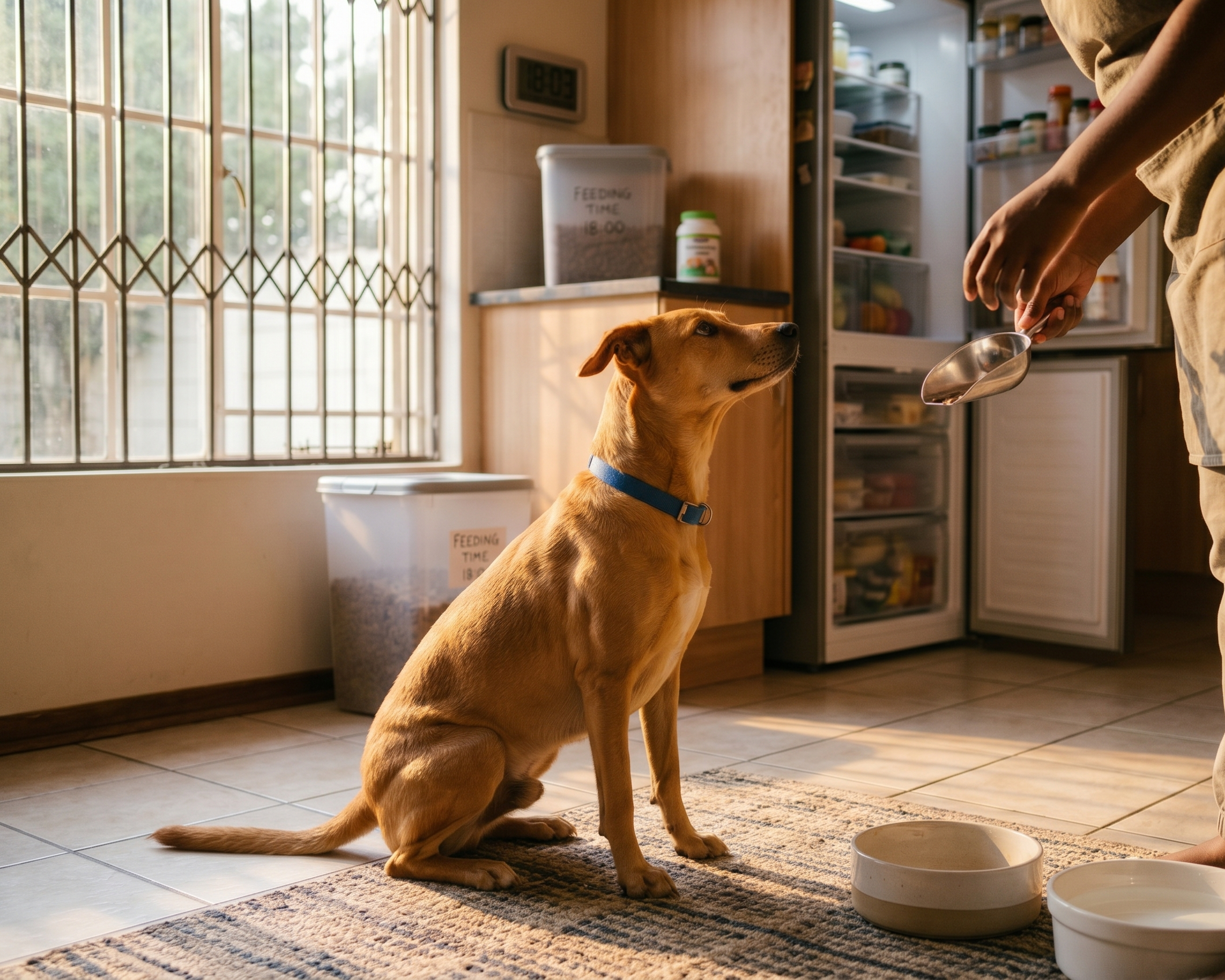
Fresh food reinforces the need for a set dog feeding time in a very practical way. Unlike dry kibble, fresh food cannot sit in a bowl safely for hours. That constraint lines up perfectly with what dogs need biologically. A proper meal at a set time, then nothing until the next one. Twice daily, spaced eight to twelve hours apart, is the standard most vets recommend for adult dogs.
Ultimately, a regular feeding schedule is less about discipline and more about working with your dog’s biology. Set a time, hold to it, and the rest tends to follow.