
Mastering giant breed puppy nutrition for a Boerboel or Great Dane presents unique challenges that differ vastly from raising a terrier. You are essentially managing the rapid construction of a massive skeletal frame that must support a heavy body for years to come. Consequently, getting the nutritional balance wrong during this critical growth window can lead to permanent orthopaedic damage.
Owners often feel overwhelmed when trying to interpret pet food labels, specifically when balancing protein requirements against the risk of allergies. A common source of confusion arises when comparing the protein percentages on wet food labels against the standards set for dry kibble. Furthermore, finding a diet that supports this massive growth while avoiding common allergens like chicken can feel impossible.
While the math may seem daunting, understanding two key concepts—Dry Matter Basis and Calcium:Phosphorus ratios—simplifies the decision-making process. By learning to read past the label’s surface numbers, you can ensure your puppy receives the nutrient density required for proper development. Therefore, education is the most powerful tool in preventing developmental diseases caused by poor giant breed puppy nutrition.
Tip: Always weigh your giant breed puppy weekly to track growth rates; rapid spikes in weight can put dangerous stress on developing joints.
The Biological Function: The Giant Breed Growth Curve
Giant breed puppies do not just grow larger than other dogs; they grow differently and for a much longer duration. Their growth plates remain open for up to 18 or 24 months, making their skeletons highly susceptible to nutritional imbalances for a long period. Consequently, they require a diet that supports slow, steady growth rather than a rapid explosion of mass.
If a giant breed puppy grows too quickly, the soft cartilage in the joints may fail to mineralise correctly into bone. This can lead to painful conditions like osteochondrosis dissecans or hip dysplasia. Therefore, the goal of giant breed puppy nutrition is to control the pace of growth through precise calorie and mineral management.
The Mathematics of Protein: As Fed vs. Dry Matter
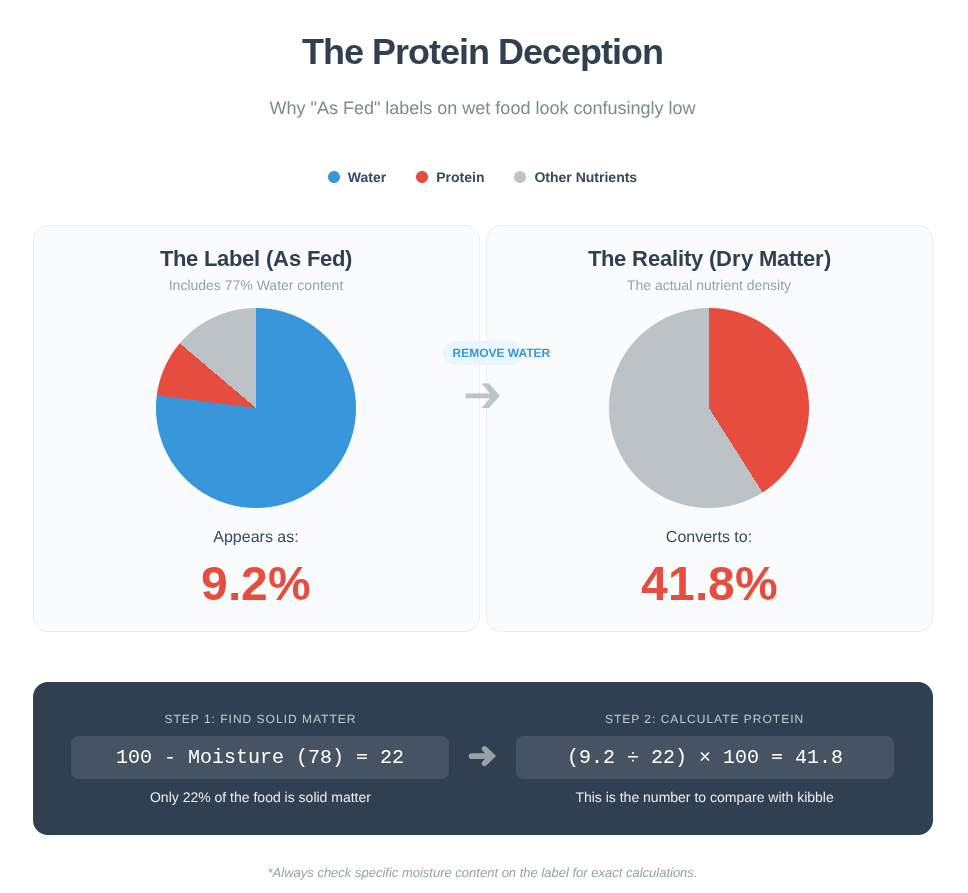
A frequent point of panic for owners is seeing a protein percentage of 9% or 10% on a package of fresh food when their vet recommends 26-28%. This discrepancy exists because wet food contains water, which dilutes the percentage shown on the label, known as the “As Fed” basis. Conversely, veterinary standards are calculated based on “Dry Matter,” which is the nutrient profile if all water were removed.
To get the true nutritional value, you must perform a simple conversion to compare apples with apples. You divide the protein percentage listed on the package by the percentage of solid matter in the food. For example, a fresh meal listed at 9.2% protein might actually convert to over 41% on a Dry Matter basis (assuming standard moisture levels around 77%), sitting well within the optimal range for growth.
Understanding Calcium and Phosphorus Ratios
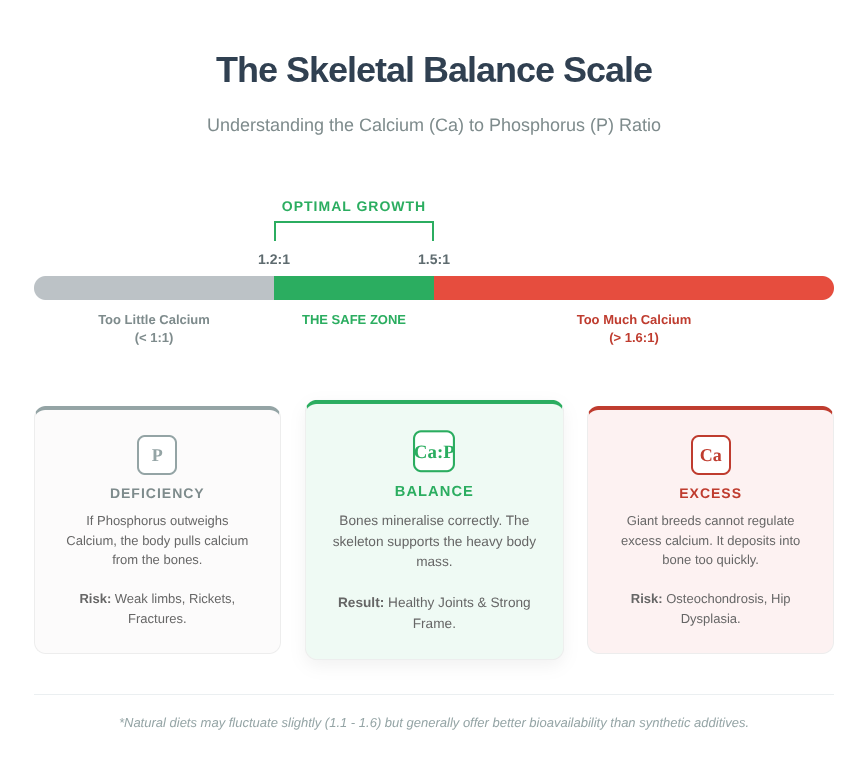
Beyond protein, the ratio of Calcium to Phosphorus (Ca:P) is the safety switch for skeletal health. Ideally, this ratio should sit between 1.2:1 and 1.5:1 for growing giant breeds to ensure bones harden correctly. Furthermore, an excess of calcium can be just as dangerous as a deficiency, causing bones to become brittle or malformed.
Synthetic diets can hit these numbers with laboratory precision, but natural diets inherently fluctuate because natural ingredients vary. A natural diet might range from 1.1:1 to 1.6:1 depending on the specific batch of ingredients. Therefore, while natural food offers superior bioavailability, it requires an understanding that biology is rarely a perfect straight line.
Managing Allergies in Giant Breeds
It is increasingly common to find giant breeds that require high-protein diets but suffer from severe chicken allergies. This complicates feeding because chicken is the industry standard for affordable, lean protein. Consequently, owners must look for novel protein sources like beef, tripe, or ostrich that provide the necessary amino acids without triggering an immune response.
Beef and Tripe Options
Formulations based on green tripe and beef are excellent alternatives for chicken-sensitive dogs. Tripe is naturally rich in digestive enzymes and probiotics, which supports the gut health of a growing puppy. Moreover, when converted to a Dry Matter basis, these meals often provide a protein content exceeding 40%, which is ample for muscle development.
Grain-Free Considerations
Some puppies may react to grains like barley or rice, which are often used as binders in fresh food. If a puppy shows signs of yeast infections or bloating, a strictly grain-free option may be considered under veterinary guidance. In these cases, protein sources like Ostrich combined with vegetables offer a hypoallergenic solution that is gentle on the digestive tract.
The Role of High-Protein Diets for Non-Allergic Dogs
For the giant breed puppy that does not suffer from allergies, a poultry-based diet remains an excellent source of lean growth fuel. Chicken and liver blends can offer extremely high protein levels, sometimes reaching 55% on a Dry Matter basis. This creates an optimal environment for building lean muscle mass without adding unnecessary fat.
However, high nutrient density must always be balanced with appropriate energy expenditure. Overfeeding a sedentary puppy can lead to obesity, which is disastrous for giant joints regardless of the protein source. Therefore, the diet must match the lifestyle and the individual metabolism of the dog.
Interesting Fact: Great Dane puppies can grow as much as 100 times their birth weight in their first year, making their nutritional needs the most demanding of all canines.
FAQs – Giant Breed Puppy Nutrition
- What is the minimum protein requirement for giant breed puppies?
While the AAFCO minimum is 22%, veterinary standards typically recommend a range of 26-28% protein on a Dry Matter basis for optimal development. Most fresh food diets easily exceed this when the water weight is removed from the calculation. - Why is the Calcium to Phosphorus ratio so important?
Giant breeds cannot regulate calcium absorption as well as adult dogs. Too much calcium can lead to bone deformities, while too little can cause rickets and weak limbs. - How do I convert “As Fed” to “Dry Matter”?
Take 100 and subtract the moisture percentage to get the Dry Matter (DM). Then, divide the protein percentage by the DM number and multiply by 100. - Can I mix kibble and fresh food?
Yes, many owners use fresh food as a topper to increase nutrient density. However, you must ensure the total Ca:P ratio remains balanced across the entire bowl. - Is barley bad for dogs?
Barley is a nutritious, slow-release carbohydrate that is safe for most dogs. However, dogs with specific grain intolerances or yeast issues should avoid it in favour of vegetable-based carbohydrates. - Does neutering affect giant breed nutrition?
Neutering removes sex hormones that signal growth plates to close, potentially causing the dog to grow taller and affecting bone conformation. Consequently, you may need to adjust calorie intake to prevent weight gain as metabolism slows. - When should I switch to adult food?
Giant breeds should stay on a growth-formulated diet much longer than small breeds, often until 18 to 24 months. Switching too early can deprive them of the minerals needed to finish bone hardening.
In Closing
Feeding a giant breed puppy is a science that balances protein density with careful mineral management. By understanding the conversion of labels and respecting the specific needs of their massive frames, you can navigate their growth phases with confidence. Ultimately, investing in their nutrition during these early months builds the foundation for a mobile, pain-free life through proper giant breed puppy nutrition.